2026:269 - Rivers, Limerick
County: Limerick
Site name: Rivers
Sites and Monuments Record No.: LI006-018---, LI006-063---
Licence number: 26E0232
Author: Ewelina Rondelez
Author/Organisation Address: Lir Archaeology Heritage and Planning Consultancy Carrigbán, Doire Na Sagart Ballyvourney Co. Cork P12KP79
Site type: Enclosure, kilns, pits
Period/Dating: Undetermined
ITM: E 563855m, N 657750m
Latitude, Longitude (decimal degrees): 52.669715, -8.534405
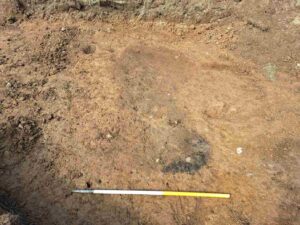
A programme of archaeological test trenching was undertaken in the townland of Rivers, Co. Limerick. A total of 51 trenches were mechanically investigated across the testing area, totalling 3813 linear metres. Several archaeological features and deposits were identified during the testing programme. The most significant feature was an enclosure ditch (C11/C12), which corresponded to a subcircular anomaly identified during the preceding geophysical survey. The subcircular enclosure was defined by an earth-cut ditch 1.8-1.9m wide, measuring approximately 32.55m north-west/south-east by 27.9m. The geophysical survey indicated a possible entrance on the south-west side. An investigatory sondage indicated a depth greater than 0.75m. Additional archaeological features identified during testing included two possible pits (C8 and C10) and multiple heat-affected features, which may represent possible kilns or associated pits (C14, C16, C18 and C20). Several of these features contained charcoal-rich deposits, oxidised clay, and evidence of in situ-burning. C14 and C20 displayed keyhole/figure-of-eight morphologies suggestive of kiln-related activity. A north-west/south-east-aligned substantial ditch with a slight curve, located 8m south-west of the north-east site boundary (C21/C22), and two short, shallow linear features, C4 and C6, were also identified within the site. Several non-archaeological features were recorded during testing, including cultivation furrows, field drains, and areas of modern disturbance and dumping associated with agricultural activity and land improvement. Although some geophysical anomalies proved non-archaeological in origin, the testing programme confirmed the survival of subsurface archaeological remains in the eastern part of the site.