2026:075 - Ballymacool, Letterkenny, Donegal
County: Donegal
Site name: Ballymacool, Letterkenny
Sites and Monuments Record No.: DG053-031
Licence number: 25E1066
Author: Gill McLoughlin
Author/Organisation Address: c/o Courtney Deery Heritage Consultancy, Unit 5B, Block F, Nutgrove Office Park, Rathfarnham, Dublin 14
Site type: No archaeology found
Period/Dating: N/A
ITM: E 615529m, N 910891m
Latitude, Longitude (decimal degrees): 54.945462, -7.757622
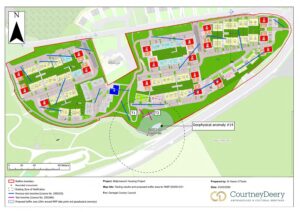
Archaeological testing was carried out on behalf of Donegal County Council, in response to a condition of planning relating to a permitted housing development in the townland of Ballymacool, on the outskirts of Letterkenny Town. This was a second phase of testing on the site and followed a desk study, geophysical survey and an initial phase of testing which avoided the geophysical anomalies closest to the recorded souterrain site DG053-031 (25E0230, excavations bulletin 2025:121).
The southern portion of the permitted development intersects with the Zone of Notification (ZoN) for a souterrain (RMP No.: DG053-031) and very little is known about this site which is marked on the First Edition 6” Ordnance Survey map as a ‘cave’. This area was excluded from the original phase of testing, but a planning condition allowed for further archaeological testing with the aim of refining the buffer zone for the monument. Testing of the two northern geophysical anomalies within the ZoN was carried out to provide further information on whether the anomalies are related to the souterrain site and if so, the nature and extent of any such remains. The southernmost anomaly (#14), being the largest and closest to the recorded location of the souterrain, was thought to be the most likely to be the souterrain or some other feature associated with it and based on there being no plans to build on that area of the site it was not deemed necessary or appropriate to test it.
The geophysical survey interpreted the anomalies in the vicinity of the souterrain as a possible curvilinear ditch, 16m in length (#12), an oblong area of low resistivity 17m x 4m (#13) and an oblong area of possible disturbed soil 18m x 7m (#14) and concluded that they could be archaeological, geological or agricultural in nature. Anomaly #14 was identified as the most likely to be the souterrain, but an agricultural or geological explanation could not be ruled out.
The testing took place over five days from 12 January 2026 targeting anomalies #12 and #13; no features, finds or deposits of archaeological interest were identified. No features werer uncovered in Trench 1 and the geophysical anomaly (#12) could be explained by variations in the natural subsoil and bedrock.In Trench 2, and its extensions to the west and east, a linear field boundary ditch, oriented north-northwest/south-southeast contained a jumble of stones and was situated mid-way between two field boundaries of the same orientation depicted on the first edition 6-inch OS mapping and it is likely that this field boundary was related to that system. The ditch was of the opposite orientation to geophysical anomaly #13, although the north and south extents of the stones corresponded with the anomaly so the presence of the stones may have influenced the geophysical interpretation in some way. In the east and west extensions to Trench 2, natural subsoil and bedrock were very clear and there was no evidence for a souterrain or any other type of archaeological site. Other features identified in Trench 2 and its extensions were a linear stone drain, a pit containing modern delph and animal-burrowing activity. A section excavated by hand across the stone-filled ditch, the stone drain and a shallow deposit east of both features confirmed that there were no features of archaeological interest and it appeared that the geophysical anomaly may have been related to a dip or hollow combined with the stones filling the linear field boundary ditch.
No further work is necessary in relation to the archaeological testing but fencing of the buffer around the recorded site and archaeological monitoring of groundworks have yet to take place.