2025:520 - 20 Francis Street, Townparks, Wexford, Wexford
County: Wexford
Site name: 20 Francis Street, Townparks, Wexford
Sites and Monuments Record No.: N/A
Licence number: 24E0348 Ext.
Author: Alva Mac Gowan / Archaeological Management Solutions (AMS)
Author/Organisation Address: Fahy’s Road, Kilrush, Co. Clare. V15 C780
Site type: Urban
Period/Dating: Modern (AD 1750-AD 2000)
ITM: E 704604m, N 621793m
Latitude, Longitude (decimal degrees): 52.337759, -6.464993
AMS were engaged by Wexford County Council to carry out archaeological monitoring of groundworks associated with a proposed development at No. 20 Francis Street. The monitoring followed a Cultural Heritage Impact Assessment and archaeological testing of the site prior to demolition works under licence 24E0348 (McGrath et al. 2024). As the Proposed Development Site lies within the Zone of Notification for the historic town of Wexford, it was recommended that site clearance works such as topsoil clearance, or other intrusive activity should be monitored.
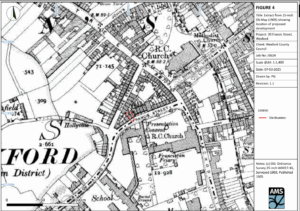
The site measures c.72m2 and is located to the northwest of a priory (WX037-032019-; RPS WBC0100; NIAH 15502158) and north of the Presentation Convent (RPS WBC0099; NIAH 15502157). The soil comprised of urban/manmade material, and the underlying bedrock consists of grey-green metagreywacke and slate of the Cullenstown Formation (GSI 2025 ).
The former property at 20 Francis Street had no legislative protection as it had not been adopted by Wexford County Council for inclusion on the Record of Protected Structures. A 2005 Survey of the asset (NIAH Reg No 15502153) by the National Inventory of Architectural Heritage described it as follows:
Terraced two-bay two-storey house, c.1875, probably incorporating fabric of earlier house, pre-1840, on site. Reroofed, c.1950. One of a group of three. Pitched (shared) roof with replacement fibre-cement slate, c.1950, terracotta ridge tiles, rendered (shared) chimney stacks having capping supporting terracotta or yellow terracotta pots, rendered coping, and replacement aluminium rainwater goods, c.1950, on rendered eaves having iron ties. Rendered, ruled and lined walls with rendered strip to end. Square-headed window openings with sills, and two-over-two timber sash windows. Square-headed door opening originally elliptical-headed with inscribed relieving arch over incorporating keystone, and replacement timber panelled door, pre-1993. Street fronted with concrete footpath to front.
In spite of being identified as being of regional significance in the NIAH, the building lay just outside of the Architectural Conservation Area delimited around the Franciscan Friary asset and Mary Street to the east. The preservation by record of the unremarkable vacant dwelling at No. 20 Francis Street. (McGrath et al. 2024) including its historic context and fabric was considered to be a satisfactory mitigation of its proposed demolition and replacement.
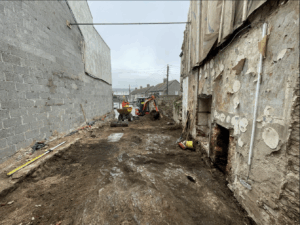
Monitoring of groundworks took place on 10 February 2025. The groundworks consisted of removing the concrete foundation until natural bedrock was exposed or to the development’s formation level 0.5–0.8m Below ground level (BGL). The underlying bedrock of grey-green metagreywacke was revealed between 0.17m and 0.3m BGL below the concrete foundation of the former property in the southern end of the plot, steeply sloping to the northwest across the site. In the corner to the northeast of the site, the lower section of the north-east boundary wall was freshly exposed after decades of overgrowth and garden build-up. Orientated northwest–southeast, this wall was shown to have been modified and repaired a number of times with several different materials including handmade brick. Formation level at the rear of the property was 0.8m BGL; this area was found to be very disturbed, containing a build-up of construction and building debris, garden and domestic waste. During test excavations in April 2024 (Stevens 2024), Trench 5 revealed the foundations of a former annex that once stood to the rear of the property. For this reason, there was a lot of modern disturbance and backfill to the rear of the property where the trench had been excavated and backfilled.
No archaeological features, deposits or artefacts were noted during the course of the ground works.