2025:583 - Castlelost Church, Westmeath
County: Westmeath
Site name: Castlelost Church
Sites and Monuments Record No.: WM033-031---
Licence number: C001405; E005755
Author: Steve McGlade
Author/Organisation Address: Archaeology Plan, 129 North Strand Road, Dublin 3, D03W8C1
Site type: Medieval church
Period/Dating: Late Medieval (AD 1100-AD 1599)
ITM: E 644895m, N 741810m
Latitude, Longitude (decimal degrees): 53.424489, -7.324527
A programme of archaeological monitoring was carried out at Castlelost Church (WM033-031-) and graveyard from September 2025 to January 2026, during repair works relating to Community Monument Fund works (CMF25-1-WM003).
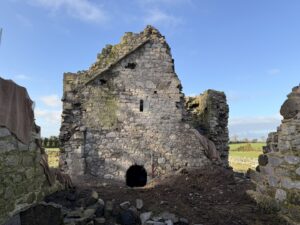
The works carried out in 2025 focused on the western residential tower of the church along with the south wall of the church.
Residential tower
An assessment of the structure of the tower was carried out following the removal of the vegetation on the tower. A number of features were revealed at this point. The original surrounds of the first floor windows to the south, east and north within the tower survive. The surrounds of the west window, and the south window for the ground floor vaulted room, were robbed out. There was evidence that the first floor window to the south had been altered at some point as there were differences in the decoration in the surround and the embrasure extended well above the top of the current window.
Evidence for two doorways in the north-east corner of the first floor room of the tower was also identified. One of these related to the access point to the first floor room, which appears to have been via a staircase in the north-west corner of the interior of the church. A drawbar slot was identified on the surviving dressed stone door jamb. The second doorway led to an intermural staircase built into the north wall. The clockwise rotating staircase does not survive, but likely provided access to an upper floor of the tower. A drawbar slot was also identified in the embrasure of the doorway to the stairs. The presence of the two entrances and probable intramural staircase in the northeast of the tower appear to have caused a structural weakness and this part of the tower subsequently collapsed.
Two steps were identified in the internal side of the east wall of the tower indicating a low upper floor was previously present within the eaves. An 18th-century cartographic depiction of the building shows a small secondary tower towards the west end of the church, which may be associated with the intramural staircase within the north wall.
The original floor of the first floor room does not survive. A fireplace was present along the west wall, though the surround for this was robbed out.
A row of stones marking the original pitch of the roofline of the church to the east survived in the east façade of the tower, with paired purlins or beam slots for the roof structure below. The distance between the purlins and the roofline stones, which would have sat directly above the roof, suggested the church had been thatched. A patch of render also survives between the window and the south wall on the east façade.
The report suggested that the residential tower was built into the western end of the church in the 15th century, likely at the same time the additional upgrades to the windows and door of the remainder of the church took place.
Once the new features were fully recorded the structure was repointed and the wall tops were flaunched. Additional conservation works to the ground floor vaulted room will be required in 2026.
Murder hole
A partially-blocked murder hole, which was noted during the works in 2024, was reopened. The upper end of the murder hole was built into the window embrasure of the window in the east wall of the tower. The surround of the upper end of the murder hole was robbed out at some point in the past, however the remainder of the chute was intact and the opening above the doorway was visible. A small area of damage in the east façade of the wall that exposed a section of the chute was repaired during the works.
The church and tower exhibit a number of defensive features, including the murder hole, the clockwise rotating intramural staircase, and drawbar slots associated with all doorways. It is clear that additional security was deemed necessary in this location in the 15th century.
South wall
Works to consolidate the arch above the internal side of the east window in the south wall were also undertaken during the 2025 conservation programme. The wall was repointed and the top of the wall was flaunched.
Masonry
Some sorting of loose debris and stone within and in the immediate vicinity of the church was also carried out for reuse in the repair works.
Some additional dressed masonry was identified within the loose rubble. The find locations were surveyed and the blocks were recorded and set aside for long-term storage. Additional masonry reused as grave-markers were also identified. These were also surveyed and recorded.
The masonry record includes a fragment of quern stone that had been reused in the north-west corner of the tower.