
2025:177 - SLIGO: Green Fort, Rathquarter, Sligo
County: Sligo
Site name: SLIGO: Green Fort, Rathquarter
Sites and Monuments Record No.: SL014-065014
Licence number: E005686
Author: Fiona Beglane
Author/Organisation Address: School of Science, ATU Sligo, Ash Lane, Sligo
Site type: Bastioned fort
Period/Dating: Post Medieval (AD 1600-AD 1750)
ITM: E 569544m, N 836290m
Latitude, Longitude (decimal degrees): 54.274505, -8.467607

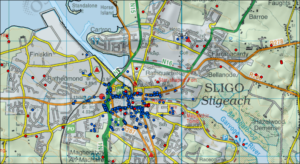
The Green Fort is a 17th-century earthwork artillery fortification (bastioned fort), located in Rathquarter townland in Sligo town. This was the first of a planned total of five excavation and two post-excavation seasons, designed primarily as a training excavation with an additional focus on community outreach. The Green Fort is protected under a dedicated Preservation Order (no. 2/83, dated 02.03.1983) and is located within the zone of archaeological potential of the historic town of Sligo (SL014-065—-). It is in shared public ownership with public access. It is one of 65 bastioned forts in Ireland, and one of seven such sites in Co. Sligo.
The results so far are extremely promising, with a series of large finds-rich deposits spread across the interior of the fort. In particular, two substantial deposits appear to be demolition debris that was spread across the interior of the fort, probably to provide a more level surface for later activities. These contained significant quantities of brick, slate, possible floor tile, glass, pottery, narrow-bore clay pipes, and military finds such as musket balls and a possible gunflint, as well as a number of prehistoric chert lithics. The lack of twentieth- and twenty-first-century finds and the presence of the military finds suggest that these deposits originated on the site and were laid down in the historic period, rather than having been brought in from elsewhere as part of e.g. park landscaping works or waste disposal.
In the northern part of the trench was a deposit that was probably originally relatively sterile but that, due to surface mixing with the underlying demolition debris, accumulated some finds. This began as a very thin deposit, and increased in thickness towards the edges of the fort. The central area of the fort is low-lying and the ground then slopes upwards on all sides to meet the low banks at the edges of the fort. These are no more than 0.5m above their immediate surroundings and would have had no practical defensive purpose. The present working hypothesis is that the sterile deposit was created by slighting the banks of the fort inwards. This would need to be confirmed by excavation further up the slope towards the edges of the fort. It is tentatively suggested that this, and maybe also the underlying levelling deposits, may be associated with the preparation of the fort for the defence of Sligo against Humbert’s forces in 1798 when Captain William Smith of the Loyal Essex Fencible Infantry is recorded as having levelled the fort to mount artillery guns facing the principal approach roads to Sligo (Clements 2021).
Below the demolition/levelling deposits, in situ archaeological features are beginning to emerge. The presence of two large areas of in situ burning, which may be the bases of e.g. kilns, or the locations of intense bonfires, and a stone-built drain, demonstrate that intact features are preserved and that further excavation is worthwhile. The date of these features presently remains unknown, however they are likely to be from the post-medieval/early modern period. A circular anomaly identified by geophysical surveys in the interior of the monument appears to be the low-lying area of the centre of the fort rather than being a structure per se. No evidence has yet emerged for an early medieval horizon, however excavations below the demolition/levelling deposits have so far been limited. There are however a significant number of chert lithics and possible lithics, which indicate prehistoric activities at the Green Fort.
Due to the overlying demolition/levelling deposits the geophysical survey data was of limited value, with in situ archaeology being masked by metal, charcoal and other debris in the upper levels. As all the spoil was sieved; metal detecting of this did not recover any additional artefacts.
Reference
Clements, B. 2021. Captain Sir William Smith Bt. Assistant Engineer Lough Swilly. Journal of the Society for Army Historical Research. 99:398, 303-311.