2025:445 - BENNETSTOWN, NAULSWOOD, AND WOODPARK, Meath
County: Meath
Site name: BENNETSTOWN, NAULSWOOD, AND WOODPARK
Sites and Monuments Record No.: N/A
Licence number: 25E0365
Author: Chris Coffey, IAC Ltd.
Author/Organisation Address: Unit G1 Network Enterprise Park, Kilcoole, Co. Wicklow
Site type: Excavation - miscellaneous
Period/Dating: Undetermined
ITM: E 701000m, N 744200m
Latitude, Longitude (decimal degrees): 53.438205, -6.479861
Archaeological testing was undertaken in association with a proposed development located at Bennetstown, Naulswood, and Woodpark, Co. Meath. The site comprises 15 fields of pasture bordered by tree-lined field boundaries and hedgerows. The surrounding landscape is characterised by agricultural fields of pasture and is located c. 1km northeast of the town centre of Dunboyne.
Testing was carried out over the course of three days from 7 May, 2025. A total of 14 trenches, which measured c. 350 linear metres in total, were mechanically investigated across the test area. Testing revealed four areas of previously unrecorded archaeological interest, Archaeological Areas 1–4 (AA1–4).
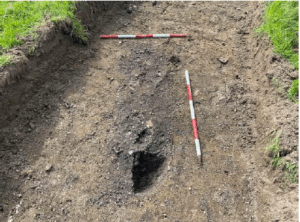
AA1 and AA2 each comprise the shallow remains a circular ditch infilled with a clay rich in animal bone; a figure-of-eight-shaped pit was also identified in the interior of AA1. AA3 comprises the remains of two parallel – or concentric – ditches, which may represent the partial remains of a larger enclosure. The geophysical survey shows these features terminating north and south of the trenches, presumably indicating damage or truncation at a later stage and, as such, the original form of these features is not currently known. AA4 comprises the remains of two circular features. Although these did not initially seem to be concentric, the larger of these ditches does seem to partially surround the smaller. A truncated pit was further identified within the interior of these features. On current evidence these remains could date to the prehistoric or medieval period, and functions could range from domestic to funerary. The remainder of the site contained multiple post-medieval and modern field drains of varying orientations and construction. These included narrow vertical stone-filled drains and wide shallow silt-filled drains.