2025:414 - PATRICKSWELL: Attyflin Estate, Limerick
County: Limerick
Site name: PATRICKSWELL: Attyflin Estate
Sites and Monuments Record No.: LI021-025001
Licence number: 25E1158
Author: Michael Greiner & Seán Shanahan; Shanarc Archaeology Ltd.
Author/Organisation Address: Unit 39A, Hebron Business Park, Hebron Road, Kilkenny
Site type: Burnt spread and Pit
Period/Dating: Undetermined
ITM: E 551292m, N 648237m
Latitude, Longitude (decimal degrees): 52.583236, -8.718733
Archaeological test-excavations were carried out in December 2025 in relation to the proposed development of a private residential development in the grounds of Attyflin Estate, Patrickswell, Co. Limerick.
The site comprised a c. 2-hectare greenfield plot located on the western side of Attyflin Estate, to the west of Attyflin Park house, a protected structure (RPS Reg. No. 6067) built c. 1770. The house is listed in the National Inventory of Architectural Heritage (NIAH) as Ref. 21902131.
The site falls within the wider Zone of Notification for a complex of monuments comprising a deserted medieval settlement (LI021-025001-), a moated site (LI021-186—-) and a trackway (LI021-025003-), as well as a children’s burial ground (LI021-025002-).
Prior to testing, the site was subjected to a geophysical survey, carried out by Shanarc Archaeology Ltd., under survey licence no. 25R0440. The geophysical survey identified multiple potential archaeological features, primarily in the form of potential pit-type features and several larger areas of concentrated magnetic response.
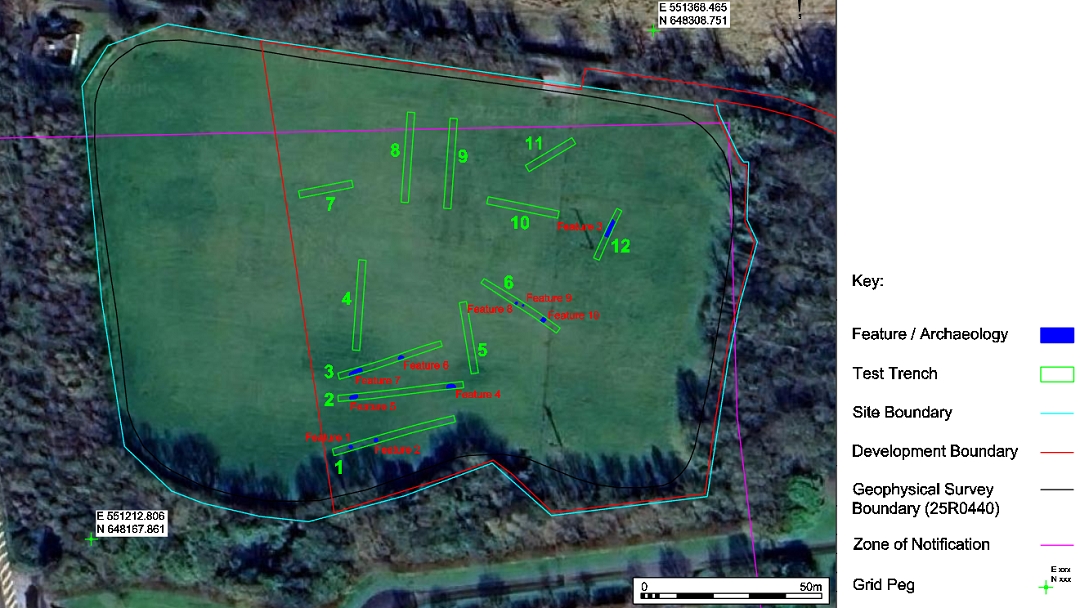
Testing comprised the excavation of twelve targeted test-trenches. The test-trenches were focused on the footprint of the proposed development and on any of those anomalies identified as potential archaeology in the geophysical survey data.
Ten archaeological and/or potential archaeological features (Features 1–10) were identified in five of the excavated trenches (Trenches 1, 2, 3, 6 & 12). The identified features primarily comprised pits, and/or small areas of possible burning, with one large burnt spread or possible burnt mound deposit being identified in Trench 12.
Concurrently to the test-excavations a metal detection survey (Detection Device Licence No. 25R0540) of all excavated spoil was carried out. The metal detection survey identified one metal tine from a modern haybob in the spoil from Trench 11, and two post-medieval and/or modern iron finds comprising a nail and a possible sickle blade in Trench 5. A single sherd of post-medieval pottery was also recovered from Trench 5.