
2025:221 - CATTAN, Leitrim
County: Leitrim
Site name: CATTAN
Sites and Monuments Record No.: LE036-049
Licence number: 22E0389
Author: Aidan Harte
Author/Organisation Address: Iverin, Co. Galway
Site type: Kiln - corn-drying
Period/Dating: Post Medieval (AD 1600-AD 1750)
ITM: E 616114m, N 793676m
Latitude, Longitude (decimal degrees): 53.892240, -7.754857
An archaeological research excavation was undertaken at a Cattan, Co. Leitrim. The excavation was carried out between 18 and 22 July 2022 as part of the Sweathouse Excavations Project funded by the Royal Irish Academy (Archaeology Research Excavation Grant Scheme) and supported Leitrim County Council.
Local information indicated that a circular depression, c. 4m diameter, was a ‘place always referred to as a Sweathouse’ and that it had had a tunnel or entrance that opened to the west (i.e. downslope). This was where the excavation was undertaken at this location and consisted of a trench 5m x 2.5m, with further extensions to expose the extent of the feature.
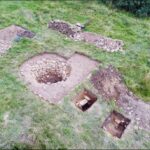
The structure excavated was a drying kiln, most likely for cereal drying. This comprised of a funnel-shaped bowl, with stone lining, 2.9m in diameter at the top and narrowing to a base c. 1.45m in diameter. It had a depth of 1.28m with a stone-lined flue opening at the base to the west (Height: 0.48m; Width: 0.62m). A second trench (1.5m x 1m) was opened 0.4m to the west. The flue was again located but the capping lintels did not remain after a combined length of 2.6m but the sidewalls did continue beyond this trench. A third trench (1.5m x 1.1m) at 1.2m further west, found no evidence of the flue or burning activity. Therefore, the flue length was originally >3m but <4.3m. A small amount of burnt material was found at the base of the flue in Trench 2. Only sparse evidence of burnt material was found within the bowl area, however several wooden branches were preserved here. These were arranged in such a way as to suggest that they were once used as a drying platform. Broken fragments of this wood (alder and willow) were sampled for radiocarbon dating. The radiocarbon analysis provided a date 273±25 bp, 2-sigma cal. range AD 1520-1795. However, probability strongly suggests a 16th/17th-century date. About a third of the basal material was excavated and the larger wood fragments retained in situ. Both the bowl and flue had filled with grey clay, up to 0.4m in thickness, denoting disuse. Within the bowl, 60%-70% of this clay was retained (unexcavated) to preserve the primary context beneath.
Stones were used to infill most of the bowl – seemingly both field clearance and subsequently more structural stone from a possible superstructure, or at least the upper edges of the bowl chamber.
The timbers at the base were covered with breathable membrane and the site was backfilled, with finer sediments at the base. The sod was replaced at the surface.