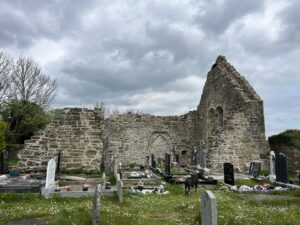
2025:179 - ROSSINVER: St. Mogue's Church, Gubalaun, Leitrim
County: Leitrim
Site name: ROSSINVER: St. Mogue's Church, Gubalaun
Sites and Monuments Record No.: LE005-003001-
Licence number: 21E0553 Ext.
Author: Steven McGlade, Archaeology Plan
Author/Organisation Address: 129 North Strand Road, Dublin 3, D03W8C1
Site type: Church
Period/Dating: Medieval (AD 400-AD 1600)
ITM: E 592315m, N 849767m
Latitude, Longitude (decimal degrees): 54.396450, -8.118341
Community Monuments Fund (CMF) conservation works at St Mogue’s Church, Rossinver, Co. Leitrim were monitored in late 2024 and early 2025. Previous archaeological investigations for CMF works to the church had been undertaken by Tamlyn McHugh under this licence, which was transferred in late 2024.
The 2024-5 works involved the partial reduction to foundation level of the central section of the north wall of the church to resolve structural issues that had caused the wall the bend in toward the interior of the church, and crack. Previous assessments of the wall indicated that it would collapse in the future without intervention to improve its structural integrity.
Both façades of the wall were numbered prior to the works. A central slot was opened through the wall measuring 1.1m on the external side and 3.3m on the internal side. The wall was reduced and a concrete slab was inserted at foundation level, with the wall subsequently reinstated above the new foundations. The wall was reinstated accurately according to the numbering system and photographic record taken prior to the works. The north wall was repointed as part of the works.
During the works for the foundations of the north wall an area adjacent to the wall needed to be excavated by hand down to foundation level to allow for the removal of the large foundation stones. This identified that there were no in situ articulated burials against the interior of the north wall of the church. It was interpreted that a charnel pit was present here, used to reinter disarticulated human remains encountered during the digging of grave cuts within the church. This cut was evident down to foundation level, and may well be the cause of the structural issues to the north wall.
An arched niche, likely originally for a later tomb, is present partially recessed into the internal façade of the north wall. This was in a poor state prior to the works as all of the dressed stone surround of the niche has been removed. The works consolidated the niche, particularly the stones in the rear that were separating from the rubble core of the wall. Where appropriate the arch was reinstated to the west, mirroring the better preserved eastern side. The works have secured this interesting component of the structure.
During the works a cup-marked stone was retrieved from the foundation of the north wall. This is the second cup-marked stone to be identified in the immediate vicinity of the church, with the second recorded in the graveyard. These are the only two examples of cup-marked stones currently known from Co. Leitrim and suggest an earlier phase of activity at the site prior to the establishment of the monastic foundation in the early medieval period.
A number of observations were also made on features of the church that have been revealed during the recent repair, maintenance and consolidation works. There is a suggestion that the remains of a gated entrance structure may be a late medieval or post-medieval addition. There is also evidence to suggest significant reworking of the external façade of the east gable prior to the recent conservation works, and that the current double lancet window may originally have been a triple-light lancet window. Previous works have uncovered a number of features indicating the western end of the church was divided off from the main body of the church with a cross-wall, with the western end subsequently serving as a residence. The flue of a chimney, a probable fireplace and a corbel that may have supported fireplace architecture were all previously identified, along with a blocked door that would have connected the church with the residence. This alteration is likely to have taken place in the late medieval period. Evidence for a doorway defended by a drawbar was identified in the south wall, and would have accessed the residence. Dressed masonry was also identified, reused as a gravestone in the graveyard south of the church, as well as in the current graveyard wall.
Recomendations were made for future surveying and storage of stone artefacts.