2025:723 - Isertkelly North, Galway
County: Galway
Site name: Isertkelly North
Sites and Monuments Record No.: GA114-097001
Licence number: 23E0688
Author: Dominic Delany
Author/Organisation Address: Dominic Delany & Associates, Creganna, Oranmore, Co. Galway
Site type: Church & graveyard
Period/Dating: Late Medieval (AD 1100-AD 1599)
ITM: E 566834m, N 719503m
Latitude, Longitude (decimal degrees): 53.224892, -8.496678
A third and final phase of conservation works was carried out at Isertkelly Church, Co. Galway, in September-October 2025. The works were funded under the Community Monuments Fund 2025 and follow on from a Conservation Management Plan funded under the Community Monuments Fund 2022, and two phases of conservation works carried out under funding from the Community Monuments Fund 2023 and 2024. The 2025 works consisted of repairs to the graveyard’s north boundary wall, the sorting of loose rubble within the church, and recording the 17th/18th-century grave slabs.
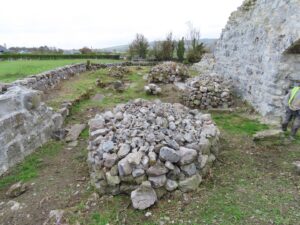
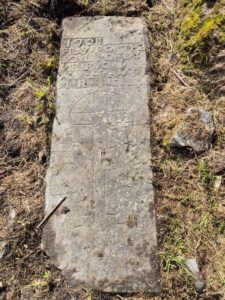
The rubble mound that had been sorted as part of the 2024 conservation works was rearranged, with the large stones used to build a ‘well’ to contain the smaller stones. Attention was then turned to the large rubble mound in the south-east part of the church. This mound resulted from the partial collapse of the east part of the south wall of the church sometime after 2008 – a photograph from that year shows that this section of wall was standing at that time, and three grave slabs are visible close to the base of the wall. The grave slabs were uncovered, and the rubble rearranged into two piles, an elongated mound incorporating the chunks of ex-situ masonry and a second stone ‘well’. Eight architectural stones were recovered during the course of this work, including six roughly worked red and yellow sandstone blocks that probably belong to the partly-collapsed south window. The 17th/18th-century grave slabs were cleaned using soft brushes and water, and recorded by means of photographs and written descriptions. The slabs feature a range of carvings – Calvary crosses (5), inscriptions carved in relief (2), occupational symbols (2), and decorative carvings (2). A headstone featuring carved decoration was also recorded.
The final phase of work was concerned with the repair of the much-collapsed north boundary wall. Part of the boundary wall was destroyed when the west part of the north wall of the church fell outwards in the late 20th century. The remainder of the boundary wall is in very poor condition, and mostly consists of loose stones randomly thrown up on top of what little survives of the original double-leaf drystone wall. The loose stone was taken down to the top of the original wall, and a new double-leaf dry stone wall was built up from this level. A further two architectural stones were retrieved during the course of this work. Prior to the commencement of this project in 2022 the church ruin was in an extremely vulnerable state with several collapses recorded in living memory. As a result of the works the church ruin is now conserved, and the site is presentable and accessible.