2025:711 - Shankill Castle, Ferndale Road, Shankill, Dublin
County: Dublin
Site name: Shankill Castle, Ferndale Road, Shankill
Sites and Monuments Record No.: DU026-052001
Licence number: 24E0810
Author: Antoine Giacometti
Author/Organisation Address: Archaeology Plan 129 North Strand D03 W8C1
Site type: Castle
Period/Dating: Late Medieval (AD 1100-AD 1599)
ITM: E 724126m, N 721285m
Latitude, Longitude (decimal degrees): 53.227443, -6.140951
Archaeological monitoring of conservation works continued into 2025 funded by the Community Monuments Fund. Refer 2024:322 for previous year.
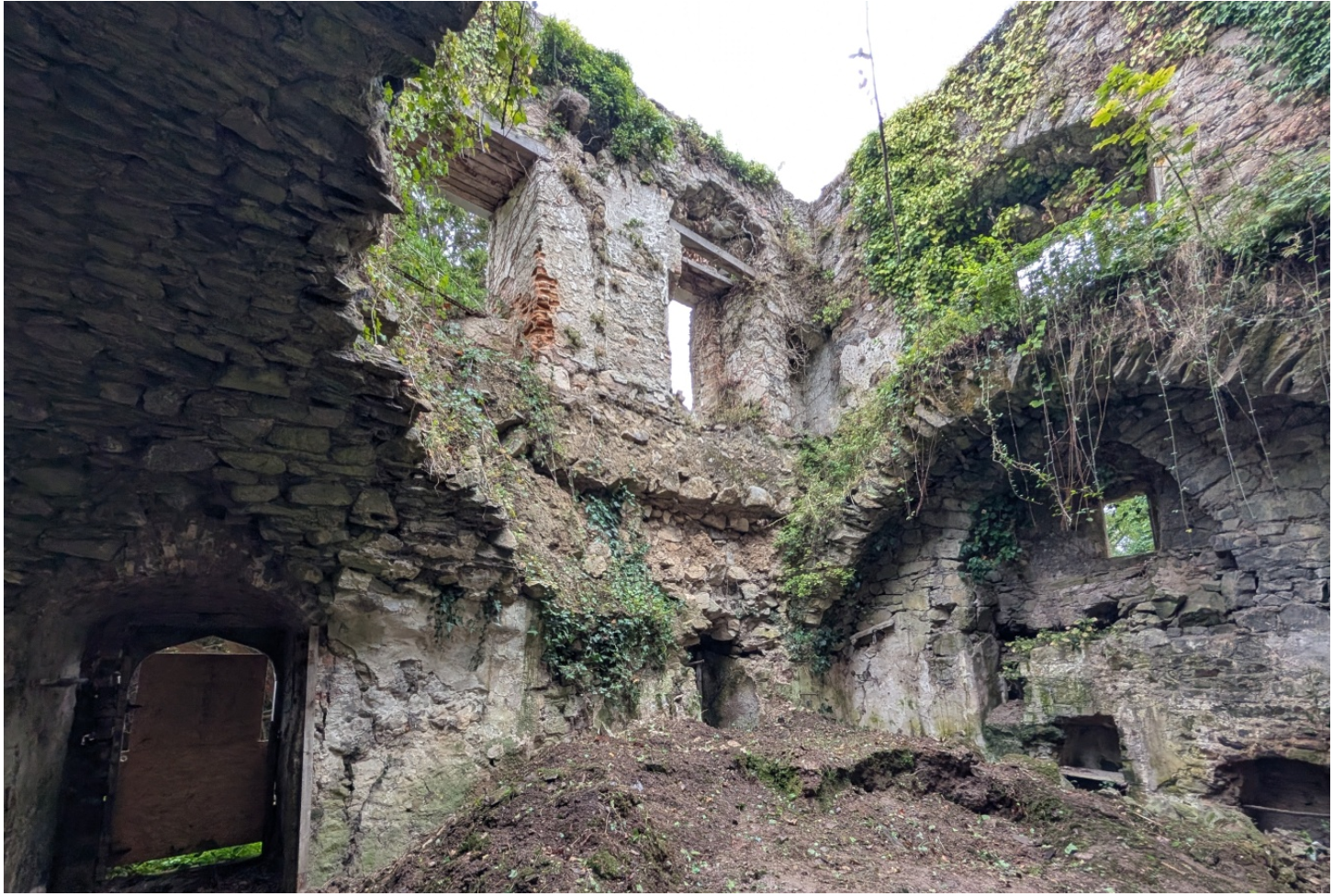
The removal of the vegetation in the eastern corner of the castle revealed a new feature. This was possibly a doorway at first floor level at the far southern end of the east wall leading into the garderobe. The door was defined by rough granite jambs to either side and measured only 800mm wide, and the base of the door corresponded to a narrowing of the facade at the same level as the first floor top of vault. The top of the door could not be confidently identified but it is possible it was a pointed arch similar to the staircase doors, in which case it measured 1.5m to the underside of the pointed arch. The doorway opening appeared to be fully infilled with brick with heavy external mortar. The left side of the doorway is c. 1m from the corner of the castle, meaning the doorway entrance is flush with the interior of the 1m-wide castle wall. It is unclear to which phase of the castle this doorway belonged, but it certainly predates the c. 18th-century upper floor windows and the 1722 and 1797 drawings of the castle.
A number of other features in the stonework surrounding this doorway were also apparent, particularly around the south-east corner of the castle. None of these could be interpreted. They must relate to a number of phases of rebuilding and renovation, again most likely pre-18th century. Since these unexplained features are concentrated at the point where the ground floor and first floor meet, it strengthens the possibility that the vault was added later to a pre-existing castle without a vault. The presence of this doorway may also suggest that the garderobe was added as a secondary feature to the existing second storey.
More information on the phasing of the post-medieval plasterwork was obtained. The only artefact discovered was a complete 18th-century glass bottle (found by the current owner among a later collection of port ).