
2024:876 - Girley Graveyard, Meath
County: Meath
Site name: Girley Graveyard
Sites and Monuments Record No.: ME023-015001
Licence number: E005741
Author: Niall Roycroft
Author/Organisation Address: c/o Meath County Council, Buvinda House, Dublin Road, Navan, Co Meath. C15 Y291.
Site type: Graveyard
Period/Dating: Modern (AD 1750-AD 2000)
ITM: E 671087m, N 769020m
Latitude, Longitude (decimal degrees): 53.666094, -6.924332
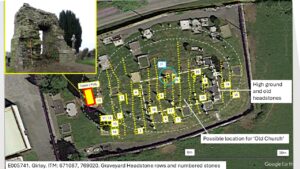
Meath County Council repaired an 18th-century tower folly in Girley Graveyard ME023-015001, Girley townland, County Meath. Girley Church ME023-015 has no above ground visibility.
The NMS description of ME023-015 and the Meath History Hub suggests that the structure due for conservation is of 18th-century date, relating to the Girley Church. However, it is more likely that the ‘tower’ is an 18th-century folly (ornamental ruin) and is perhaps not located in the area of the original church. This folly was probably constructed because the entire church had been erased (and the stone probably used in the graveyard boundary wall) and some ‘vertical and romantic feature’ may have been desired on the site. The original location of the church is proposed on the higher ground to the east of the ‘folly’.
Consent of C1401:E005741 was issued in August 2024 and works were begun in October 2024. Works were suspended in the winter of 2024-2025 and were completed in Spring 2025.
Conservation works on the ‘folly’ revealed nothing of archaeological interest. Several areas where corners had fallen were reconstructed and the rest of the structure was repointed and strengthened where necessary. However, stones that had been previously piled around the base of the folly included four large pieces of medieval window tracery (15th – 16th century in date) and a survey of the graveyard showed:
• an additional 12 church pieces of 10x window jamb fragments and 2x sills,
• an early medieval cross-inscribed stone (similar in design to that in St John’s Graveyard ME017-044035 in nearby Kells) reused/relocated as a headstone,
• a holed stone (funnel-shaped hole from one side only similar to a pivot stone, but reused as a headstone),
• a triangular-shaped stone, possibly an arch springer stone
• a large, squared, flat stone with scrollwork edges that might have been a small table tomb, reset on edge as a headstone,
• a mostly buried rectangular stone with a flared carving in relief and two sockets (one still containing lead) for iron rods.
A loose, stone-kerbed circle 4.28m in diameter around a large, unworked, flat, uninscribed and vertical ‘headstone’ in its centre was noted as unusual.
The window tracery and most of the jambs are all in good condition and all are or were presumably reused as headstones. The tracery allows conjectural reconstructions of the possible east window and perhaps the west window of the church to be proposed.
All worked stones have been retained on site. Stones 1-10 and Stones 16-21 are in use as grave markers. Stones 11-15 had been previously found, presumably during grave digging, and had been placed around the base of the folly. The SMR stones supposed to be located in the graveyard wall had been previously removed by OPW.