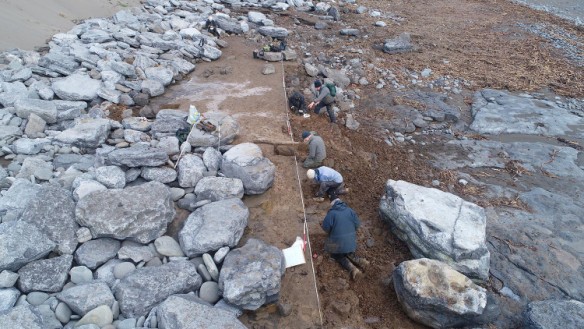
2024:453 - BALLAGHALINE, Doolin, Clare
County: Clare
Site name: BALLAGHALINE, Doolin
Sites and Monuments Record No.: CL008A-010
Licence number: 15E0145
Author: Michael Lynch
Author/Organisation Address: Leana, Killinaboy, Co. Clare.
Site type: Axe factory
Period/Dating: Mesolithic (8000 BC-4001 BC)
ITM: E 506342m, N 696532m
Latitude, Longitude (decimal degrees): 53.011290, -9.395677
The monitoring of the clay layer beneath the storm beach at the mouth of the Aille River in Ballaghaline, near Doolin, which has been ongoing since 2014, continued in 2024. This recording of areas of erosion where concentrations of shale flakes, axe roughouts and hammerstones were identified led to the excavation from 2015 to 2023 of Trenches 1 to 7 (see Excavations.ie 2015:143; 2017:206; 2018:324; 2019:317; 2020:258; 2021:339; 2022:452; 2023:451). The excavations have shown that the knapping of shale axe roughouts as well as other tools was carried out across a large area of what is now a storm beach. Whilst most of the shale flakes are from the preparation of axe roughouts, some flakes represented the production of alternative tools, such as blades. This material is similar to that recorded by M. Knowles at the end of the 19th century.
In April 2023 the excavation of Trench 7 commenced and a further short period of excavation took place in November 2023 before Trench 7 was re-covered by the storm beach.
In January 2024 Trench 7 was again exposed by changing tidal conditions allowing excavation to resume for a short period until the Trench was again covered over by the storm beach. Continual monitoring of the site took place during 2024 and it was not until October that suitable conditions allowed the resumption of the excavation over a period of 4/5 weeks. Trench 7 proved to be the most archaeological rich Trench excavated to date. As before, numerous axe roughouts and blanks, hammerstones and many concentrations of flakes and fragments were recovered. One part of the trench had the highest concentration of material experienced on the site to date. Numerous samples of charcoal associated with the archaeological material were also recovered which, when dated, should add to the Mesolithic chronology already established across the site.
The licenced monitoring and collection of surface finds from the survey area continued during 2024. This confirmed that the erosion of the clay layer beneath the storm beach is continuous and that archaeological material is still being uncovered by the sea. It is proposed to continue with monitoring and the collection of surface finds during 2025 with appropriate excavation when suitable conditions arise.
Acknowledgements:
Thanks are due to the landowner, Mr. Cyril Nagle, for his permission to access and excavate the site and to the Burrenbeo Trust Conservation Volunteers for their essential contribution. Thanks are also due to the NMS and NMI for the extensions of the licence for the excavation, monitoring and collection of surface finds on the site.
References
Knowles, M 1901, Kitchen Middens, Co. Clare. Journal of the Limerick Field Club 2, 35-42.
Lynch, M. 2017. The Later Mesolithic on the North-West Coast of Clare. Archaeology Ireland Vol. 31. No.4.