2023:732 - KNOCKBROGAN, Bandon, Cork
County: Cork
Site name: KNOCKBROGAN, Bandon
Sites and Monuments Record No.: N/A
Licence number: 23E0791
Author: Peter Looney
Author/Organisation Address: 3a Westpoint Trade Centre, Link Road, Ballincollig, Cork
Site type: Habitation site
Period/Dating: Bronze Age (2200 BC-801 BC)
ITM: E 549275m, N 555617m
Latitude, Longitude (decimal degrees): 51.750585, -8.734653
An archaeological excavation at Knockbrogan, Bandon, County Cork followed the discovery of several discrete features of archaeological potential within the site during a programme of geophysical survey (21R0195), and a subsequent programme of archaeological testing (21E0699). The geophysical survey identified several anomalies that were considered to potentially be archaeological in nature.
Four areas with features of archaeological potential were identified during the programme of test trenching and these were investigated and excavated in October 2023. These are referred to as Areas A, B, C and D.
Area B
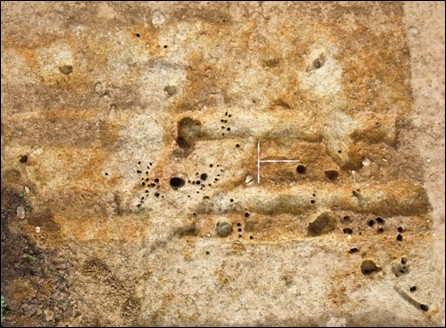
110 cut features were excavated in Area B, consisting of pits, post- and stake-holes, all within an area of 10m x 7m. No occupation layers survived, which could have given an indication of the interior of any potential structures. In addition, a range of east-to-west orientated furrows cut into the level at which the features were found and may have destroyed other more shallow features.
There was without doubt some form of at least temporary structure or structures within the site, though it is not certain exactly what form this may have taken. A number of potential circular and rectangular shapes can be feasibly seen by connecting three or more of the cut features.
Artefacts recovered from Area B, consisting of pottery and two stone artefacts, gave a preliminary prehistoric date range for the site during the excavation.
Area C
A smaller collection of features, two pits and two stake-holes, were excavated in Area C, c. 75m to the east of the activity in Area B. No artefacts were recovered from that Area, meaning that a general date range for the activity was difficult to estimate during the excavation.
Radiocarbon Dates
Radiocarbon dates were returned from samples taken during the excavation, two from Area B and one from Area C. Though small in number, the three dates returned were all close, dating to the Late Bronze Age (988–832 cal BC, 987– 831 cal BC, 1000–890 cal BC – 2 sigma). From the radiocarbon dates, it is likely that the activity in Areas B and C was contemporary and that the activity at the site during the Late Bronze Age was short-lived. This may represent a temporary camp and the material culture was domestic in nature and related to settlement.
Three charcoal samples were analysed from samples taken at Areas B and C. Three native Irish tree taxa were identified with oak the most commonly occurring, followed by hazel and with a single example of ash identified.
Artefacts – all Area B
The stone artefacts recovered from Area B were an incomplete saddle quern (23E0791:3) and a perforated stone disc (23E0791:2). The saddle quern is of a type that was in use throughout the Neolithic and Bronze Age, but most frequently associated with Late Bronze Age sites. The perforated stone object may not have been a completed piece, and instead be a roughout that was never finished. It is similar to stone objects that have been identified from Late Bronze Age sites including Knockadoon, Lough Gur, County Limerick and Ballyveelish, County Tipperary. Its most likely intended purpose was as a spindle whorl for use in the production of yarn.
The pottery, 70 sherds in total, was all recovered from the same pit in Area B and all representative of the same vessel (23E0791:4-73). The entire vessel was not present. The vessel is consistent with Late Bronze Age pottery in Ireland. It had a simple rim and likely a flat base, though the intersection of body and base was not present. The pottery had a coarse fabric and no decoration was identifiable. This pottery is similar to pottery found in Late Bronze Age sites.
The presence of pottery is an indication of food storage or preparation at the site, though no charred food remains were identified on any of the pottery sherds. The saddle quern indicates the processing of grain for food production, while if the perforated stone object is a spindle whorl, this indicated the processing of yarn for clothing of other purposes.
The pottery and the two stone tools are all consistent with the Late Bronze Age radiocarbon dates returned for the site and together indicate that the archaeological features at the site represent a single and brief phase of activity at the site in the Late Bronze Age.
Remainder of site area
The potential features that had been identified during testing in Areas A and D were investigated and deemed to not be archaeological in nature, while no additional archaeological features were identified during the monitoring of topsoil removal in the remainder of the site.
Conclusion
This Late Bronze Age site contributes to our understanding of the time period in the Bandon area. There are dated, contemporary sites in the wider area, including at Clashanimud Hillfort, while there are also closer features that may be contemporary, these consist of standing stones and fulachtaí fia. Settlement or camp sites such as this site at Knockbrogan are less prominent in the landscape and are generally not identifiable without significant archaeological investigations. In the case of this site, the excavation followed a programme of archaeological geophysics and then test trenching. It is plausible that many more sites similar to this may be located within the wider area.