
2022:930 - ALTEENACRES GLEBE, Leitrim
County: Leitrim
Site name: ALTEENACRES GLEBE
Sites and Monuments Record No.: LE016-023
Licence number: 22E0288
Author: Aidan Harte
Author/Organisation Address: Inverin, Co. Galway
Site type: Sweathouse
Period/Dating: Modern (AD 1750-AD 2000)
ITM: E 596646m, N 827262m
Latitude, Longitude (decimal degrees): 54.194279, -8.051396
An archaeological research excavation was undertaken at a sweathouse at Alteenacres Glebe, Co. Leitrim (RMP No.: LE016-023). The excavation was carried out from 2–10 May 2022 as part of the Sweathouse Excavations Project funded by the Royal Irish Academy (Archaeology Research Excavation Grant Scheme) and supported by Leitrim County Council.
The site, recorded as a ‘Vapour Bath’ on the 1835 edition O.S. map, and subsequently as ‘Sweat House’, now survives as a collapsed mound in forestry plantation. It had not yet collapsed by the late 1970s and it reputedly stood to a height of 1.8m in the 1990s. In 2021, the Leitrim Sweathouse Project recorded the internal diameter as 2.8m and no internal measurements had been recorded prior to this. The excavated trench included the circular internal area of the sweathouse chamber, 2.91m south-east/north-west by a maximum 3.6m, with an extension 2.4m to the southeast, 1m in width.
The chamber was represented by a floor comprised of both cobble- and flagstones set tightly, intermittently bounded by the basal course of the structural walls. The heat-affected floor and lower course of wall masonry defined an almost circular area, 1.84m north-south x 1.76m. The entrance was 0.52m in width and at least 0.6m in length and opened to the southeast. From the entrance, a series of large stones stepped down in the direction of the river (2.5m to south). The path/steps became covered by burnt rake-out, mound slippage and weathered debris throughout the site’s period of use. Within the chamber, only thin remnants of burning episodes remained.
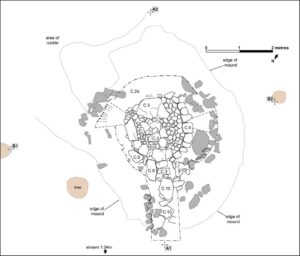
There was not enough stone within the collapsed mound to have formed either the walls or roof of the sweathouse chamber. The mound material had subsided into the central depression. Although severely impacted by roots from nearby trees – planted in the 1990s – it appears that the masonry of the structure was purposefully ‘robbed-out’ prior to this.
Only modern pottery sherds – all from the same vessel – were recovered from the surface layer over the chamber. Almost all the sampled burnt material consisted of turf embers. Charcoal (alder and oak) was recovered from the steps outside the entrance (alder) and within the collapsed mound material (oak), and the former was forwarded for radiocarbon dating and produced a date 174±24 BP, 2-sigma calibrated date range AD 1661–1950.
The site was backfilled and secured to allow the backfilled materials to settle.