
2022:929 - KILLADISKERT, Leitrim
County: Leitrim
Site name: KILLADISKERT
Sites and Monuments Record No.: LE018-062
Licence number: 22E0289
Author: Aidan Harte
Author/Organisation Address: Iverin, Co. Galway
Site type: Sweathouse
Period/Dating: Modern (AD 1750-AD 2000)
ITM: E 593777m, N 825065m
Latitude, Longitude (decimal degrees): 54.174510, -8.095314
An archaeological research excavation was undertaken at a sweathouse at Killadiskert, Co. Leitrim (RMP No.: LE018-062). The excavation was carried out from 11–13 May 2022 as part of the Sweathouse Excavations Project funded by the Royal Irish Academy (Archaeology Research Excavation Grant Scheme) and supported by Leitrim County Council.
The site had previous been recorded as ‘Not visible at ground level.’ (Moore 2003, 222). However, the site was located in 2021 during the Leitrim Sweathouse Project. The upstanding structure is 2.15m in height, built into a field boundary, with a low entrance opening to west. The structure is dry stone built, corbelled, with a large capstone collapsed into the sub-circular chamber (max. diameter 1.64m).
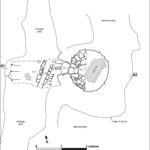
The western half of the interior was excavated, through the entrance, where a 1m wide trench extended out 1.8m. Only deposits above the floor were excavated internally. This found a level flagstone floor, with very thin overlying deposits and only trace indications of burning activity. The flagstones continued through the 0.46m wide entrance. Having both the floor and top lintels of the entrance a min. height of 0.53m was measured. Outside, to west, a wide gully ran adjacent to the field boundary, but only where the sweathouse is located. A series of large stones formed stepping-stones leading up to the entrance. Around the base of these stones, a thin ex-situ burnt deposit is the remnant of burnt material removed from the chamber. Beneath the stepping stone nearest the entrance, a stone-lined drain traversed the trench. This appears to have been used to keep the sweathouse dry but may also have served a pool further downslope.
A single find of a partial leather shoe (upper and sole) was recovered from the upper fill of the drain but was conclusively shown to be modern in date when analysed (M. Hurley, 2022). All samples were sieved and demonstrated an abundance of turf embers. Charred reeds were also noted from immediately outside the entrance. Charcoal (alder and blackthorn/cherry) recovered from both outside and inside the chamber provided radiocarbon dates of 83±29 bp and 157±23 bp. The 2-sigma calibrated date for the latter was AD 1666–1950.
The site was backfilled and cordoned off to allow the backfilled materials to settle.