2022:959 - Cloonkeenkerrill, Galway
County: Galway
Site name: Cloonkeenkerrill
Sites and Monuments Record No.: GA072-014001
Licence number: C1131, E5424
Author: Dominic Delany
Author/Organisation Address: Dominic Delany & Associates, Creganna, Oranmore, Co. Galway
Site type: Church
Period/Dating: Late Medieval (AD 1100-AD 1599)
ITM: E 561277m, N 737168m
Latitude, Longitude (decimal degrees): 53.383263, -8.582048
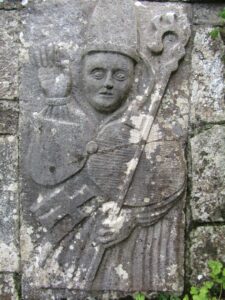
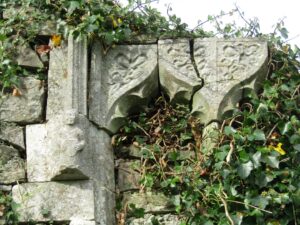
Archaeological monitoring of conservation works was undertaken at Cloonkeenkerrill Church, Co. Galway, in October-November 2022. The works were funded under the Community Monuments Fund 2022, and follow on from a Conservation Management Plan compiled under funding from the Community Monuments Fund 2021. According to local tradition Cloonkeenkerrill is the site of an early church founded by St. Kerrill aka Caireall mac Curnain, a Christian missionary active in what is now East Galway in the second half of the 5th century. The early church was later occupied by a medieval parish church, which was converted into a monastery for the Franciscan Third Order c.1435. The upstanding remains at Cloonkeenkerrill comprise the east part of the nave of the medieval/late medieval church, and the late medieval south transept. The earlier fabric consists of coursed large irregular boulders and roughly-hewn blocks while the later fabric generally consists of smaller roughly-hewn rectangular blocks and slabs. Late medieval architectural features include an impressive three-light tracery window in the south gable of the transept, fragmentary remains of two twin-light ogee-head windows in the east wall of the transept, and another twin-light ogee-head window in the south wall of the nave. The twin-light windows feature decorated hood moulds and spandrels. Of particular note is the small figure of a friar carved into the terminal stone of the hood mould in the southern twin-light window. An unusual feature of the church is the finely-carved image of a bishop inserted into the east wall of the nave. An associated plaque bears an inscription dedicated to Edmund Kelly (1658-1732) who was appointed to the bishopric in 1718. A finely carved medieval stone head is built into a modern folly known as ‘St. Kerrill’s Bed’ which is located adjacent to the graveyard’s west boundary wall.
The principal works requiring archaeological monitoring in 2022 were the sorting of the rubble mound at the base of the east wall of the nave, and the removal of blocking masonry from the tracery window in the south gable of the transept. The mound within the field at the base of the east wall is a result of the collapse of the east gable in 1983. It was cleared of scrub and a small excavator fitted with a ‘grab’ was retained to lift the larger stones from the mound, carefully placing any architectural stones to one side. Twenty-four architectural stones, some broken into small fragments, were retrieved during the course of this work. A further three architectural stones were recovered from the masonry blocking the three-light tracery window in the south gable of the transept.