2022:770 - SHANNONPARK & CARRIGALINE MIDDLE, Cork
County: Cork
Site name: SHANNONPARK & CARRIGALINE MIDDLE
Sites and Monuments Record No.: CO087-115
Licence number: 22E0027
Author: Colm Chambers, John Cronin & Associates
Author/Organisation Address: Westpoint Trade Centre, Ballincollig, County Cork
Site type: Habitation site
Period/Dating: Prehistoric (12700 BC-AD 400)
ITM: E 573258m, N 564135m
Latitude, Longitude (decimal degrees): 51.828812, -8.387975
The archaeological excavation works detailed below followed the discovery of several discrete features of archaeological potential within a proposed housing development during a programme of geophysical survey (20R0203), and a subsequent programme of archaeological testing (21E0218). The site of a levelled fulacht fia (SMR CO087-115—-) is located within the subject lands and this monument was preserved in situ.
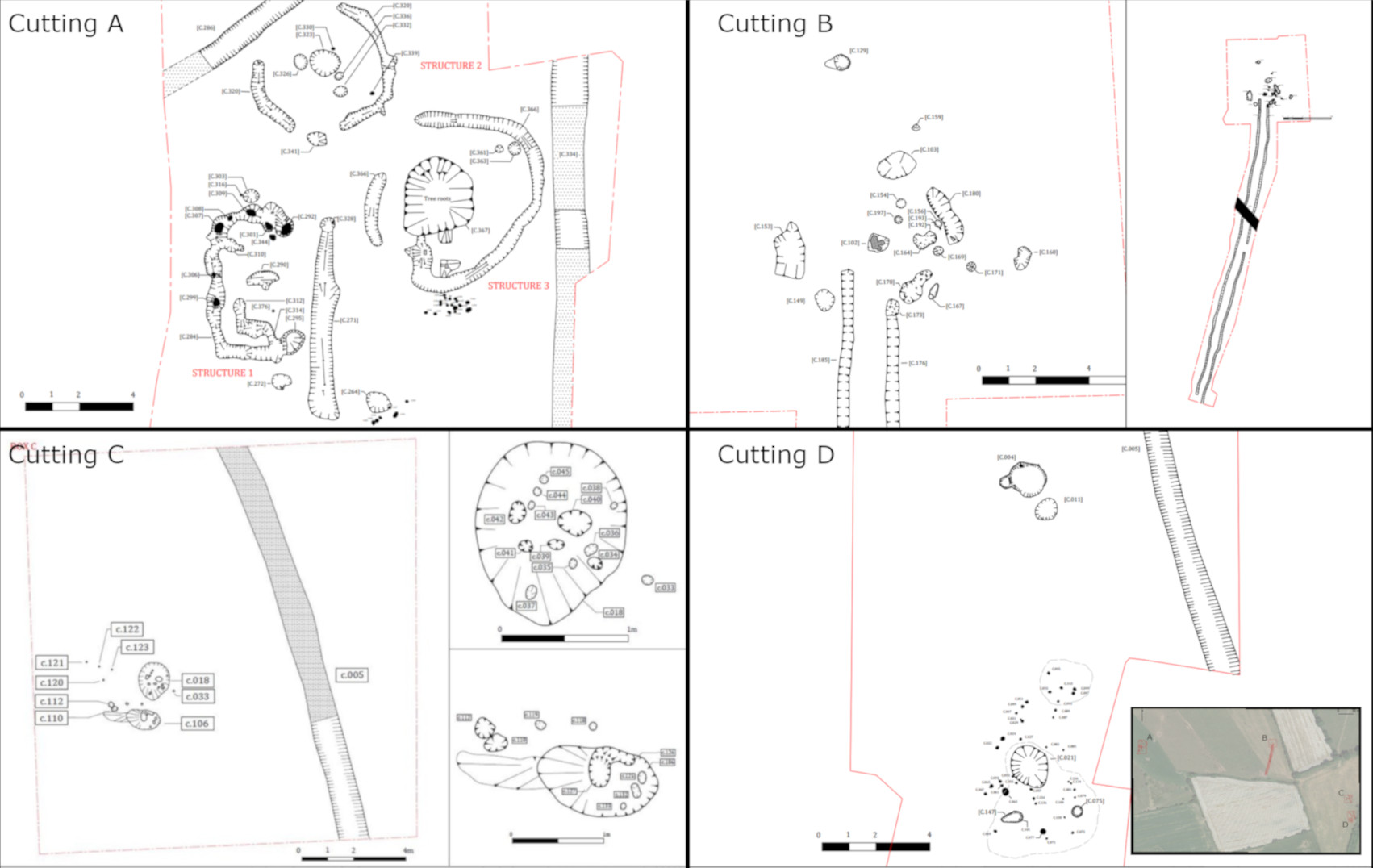
The excavation was subdivided into four areas (Cuttings A, B, C and D). Each Cutting measured 15m x 15m and Cuttings A, B and D were extended to allow for the complete excavation of the archaeological features identified.
Excavation within Cutting A identified the remains of three likely structures (Structures 1–3) and a number of related posts, pits and stake-holes. Several pieces of worked flint found within and adjacent to Structure 1 have been interpreted as being early Mesolithic in form. A sample from the fill (C.297) of the western slot trench [C.284] of Structure 1 returned a radiocarbon date of Cal BC 4833–4614. A sample from the fill (C.324) of a post-hole [C.323] within Structure 2 returned a radiocarbon date of Cal BC 5471–5230. A sample from the fill (C.381) of the slot trench [C.366] of Structure 3 returned a radiocarbon date of Cal BC 6018–5887.
Within Cutting B an area of archaeological activity in the form of a concentration of small posts, pits, and discrete areas of burning was noted. Upon submission of a revised method statement the excavation area was extended to allow for the excavation of a pair of parallel linear features, which were found to be extending to the south of Cutting B. These features were interpreted as the remains of a track or path leading to the area of activity within Cutting B and these linear features terminated within the excavation area. No finds were recovered within Cutting B. A radiocarbon date from a charcoal sample from the fill (C.175) of the post-hole [C.173] returned a date of Cal BC 964–821, indicating that the trackway and related area of activity within Cutting B represented later Bronze Age activity.
Within Cutting C a series of small pits, posts and stake-holes was noted. A number of these features were filled with a dark deposit of burnt stone, similar to burnt mound material. The activity within Cutting C was similar to that noted within Cutting D. The basal fill (C.107) of pit [C.106] and of stake-holes [C.125], [C.126] and [C.127] excavated within Cutting C returned a date of Cal BC 2337–2139, suggesting that the features noted within Cuttings C and D dated to the early Bronze Age.
The remains of the three structures and related activity within Cutting A at the site appear to represent some of the very earliest archaeological evidence identified thus far for settlement within County Cork. Radiocarbon dates for the three structures suggest the settlement activity represented the period of transition between the early and later Mesolithic and continuing into the later Mesolithic, however analysis of the lithic assemblage recovered during excavations suggests that early Mesolithic flint working was taking place. Typologically early Mesolithic lithic material was recovered from deposit (C.297), which was dated to Cal BC 4833–4614. This deposit was contained within the structural slot of Structure 1 and was interpreted as having formed during the occupation of the structure or soon after the structure went out of use. Dating evidence suggests that the site may have been in use for around 1000 years during the Mesolithic period.
A rare identification from the Mesolithic samples was the strawberry tree. This is a small tree found in open woodland and heathy scrub on rocky slopes and lake shores. It grows on a range of rock types: typically on very shallow soil, often rooted between rocks. The strawberry tree is only found growing wild in small areas of West Cork, Kerry, and Sligo today. It had been suspected that this tree species was brought to Ireland by the first metal workers during the earliest Bronze Age, about 2200 BC. However, charcoal within the sample containing strawberry tree remains identified within Cutting A was dated to Cal BC 5471–5230 suggesting that the tree was already present during the Mesolithic period and is a true native species.