2021:805 - Bowling Green, Townparks, Galway, Galway
County: Galway
Site name: Bowling Green, Townparks, Galway
Sites and Monuments Record No.: GA094-100
Licence number: 20E0591
Author: Dominic Delany
Author/Organisation Address: Dominic Delany & Associates, Creganna, Oranmore, Co. Galway
Site type: Medieval urban
Period/Dating: Medieval (AD 400-AD 1600)
ITM: E 529663m, N 725305m
Latitude, Longitude (decimal degrees): 53.273407, -9.054539
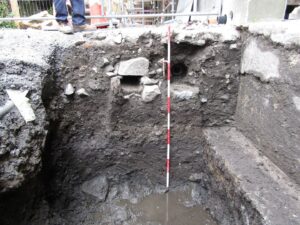
Archaeological excavation was carried out on the site of a proposed extension to an existing warehouse at Bowling Green, Galway, between 28 June and 6 July 2021. The site (dims 11.25m x 2.75m) is located within the area of archaeological constraint for the historic town (GA094-100), and lies immediately east of the town defences (GA094-100001) in the west part of the medieval town. Previous testing at the site had identified an archaeological deposit described as the ‘Galway Layer’ (2020:396).
Archaeological excavation uncovered stratified medieval, late medieval, and post-medieval layers. The post-medieval level was severely truncated by various 19th– and 20th-century developments. The vast majority of the finds recovered from this level date to the 17th and 18th centuries, and are typical of the range of post-medieval material that is generally found in Galway. North Devon is the dominant pottery type, accounting for almost 50% of the total potsherds, but Spanish, French, Portuguese, German and Dutch wares are also represented in the assemblage. The mid-17th-century Pictorial Map of Galway shows the development site located within rear gardens backing onto the town wall. The excavated post-medieval deposit, which contained domestic items (pottery, clay pipes and glass), building debris (brick, slate, pantiles, nails and mortar), and food waste (animal bone and shell), is consistent with what you might expect to find in a garden soil deposit. The underlying medieval and late medieval deposits consisted of wet and sticky clayey silts with frequent inclusions of animal bone and shell, and occasional pottery sherds. These deposits probably represent dumped domestic waste. The uppermost deposit contained pottery dating from possibly the 13th to the 17th century, although most of the pottery is consistent with a late medieval date (15th/16th century). The basal deposit yielded 16 sherds of Saintonge green-glazed pottery, securely dating this deposit to the 13th/14th century. The physical and environmental evidence suggests the ground here was wet throughout the medieval period.