2019:845 - CLN 5/6, Clonee, Loughsallagh, Portan and Gunnocks, Meath
County: Meath
Site name: CLN 5/6, Clonee, Loughsallagh, Portan and Gunnocks
Sites and Monuments Record No.: N/A
Licence number: 18E0013
Author: Jane Whitaker
Author/Organisation Address: c/o IAC Archaeology, Unit G1 Network Enterprise Park, Kilcoole, Co. Wicklow
Site type: Habitation site
Period/Dating: Multi-period
ITM: E 703316m, N 742374m
Latitude, Longitude (decimal degrees): 53.421352, -6.445616
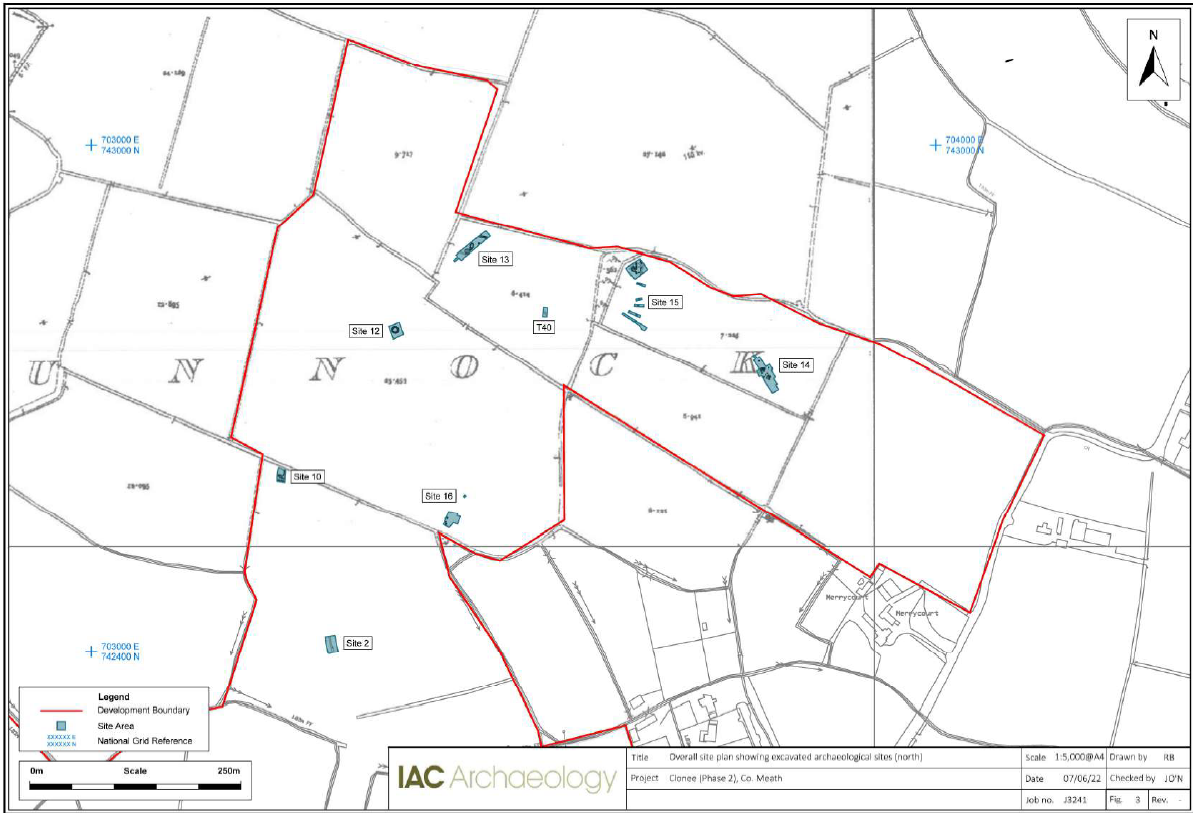
A course of archaeological excavation took place between April and July 2019, following test trenching excavations in 2018 and 2019.
Of the sixteen sites excavated during the course of the archaeological mitigation project, thirteen were confirmed to be archaeological in nature. Site 1, Site 2, and Site 5 were confirmed to be non-archaeological and agricultural in origin.
Sites 3, 4, 6, 8, 12, 13, 14 and 16 are Bronze Age in date, with dates spanning the whole period. There is dating evidence for earlier, Chalcolithic use of the site at Site 14. Site 9 is early medieval in date, while Sites 7, 11 and 15 are medieval in date.
The site comprised several phases of activity summarised below.
Neolithic 4000–2500 BC:
At the end of the Neolithic (at the southern extent of Site 14) were pits containing burnt stone with some struck flint and burnt bone and dated to 2622–2468 BC. This overlaps with the period when metal is introduced (the Chalcolithic) but before copper alloys, i.e. bronze, are in use.
Early Bronze Age 2500–1700 BC:
Two pits on Site 14 were associated with burnt stone and burnt animal bone (including cow) and dated to 2296–2053 BC. There was evidence for oat and other (unidentifiable) cereal fragments from Site 14, along with hazelnut fragments. Pits with burnt stone in their fill and dating to 2268–1979 BC were present at Site 8. The precise function of these pits is currently unknown however given the presence of burnt stone it is currently interpreted that these features are associated with burnt mound-type activity. There were some traces of charred (but otherwise unidentifiable) cereal and hazelnut associated with the features of this date at Site 8.
A burnt mound at Site 3 was in use around 2120–1950 BC and was associated with animal bones, although only a cow bone could be identified.
At Site 12 a ring ditch produced no clear evidence for burial, although coarse ware pottery, flint and burnt alder planks appear to have been deposited in the south-eastern quadrant of the ring ditch. This was dated to 1927–1750 BC.
Middle Bronze Age 1700–1200 BC:
Two isolated pits at Site 6 appear to have served as an (alder) charcoal-production pit in 1734–1532 BC.
The features uncovered in Site 4 have no clearly discernible structural pattern or function, although they do collectively have an east-west alignment and the gully to the north of the main cluster is similarly aligned. It is possible that the site is the location of a temporary settlement or bivouac consisting of light structures, possibly with a number of phases from 1500–1100 BC. Free-threshing wheat was associated with these features along with charred brambles and other unidentifiable cereals.
At Site 13 a pit, with evidence for burnt mound activity and an adult cow humerus, a large mammal rib and four indeterminate fragments was dated to 1431–1277 BC.
At Site 16 pits produced burnt stone and charcoal and were dated to 1374-1116 BC.
Late Bronze Age 1200–800 BC:
On Site 6 was the eastern half of a ring ditch with burnt animal bone, flint and a piece of coarse ware pottery dated to 1207–1006 BC. The bone was from a range of species including cattle, red deer, pig and sheep/goat. Cereals from this date included free-threshing wheat, hulled barley and oats.
The second trough/pit at Site 13 measured 4.4m by 3.6m and was 2.02m deep. It dated to 1119–930 BC and contained 44 animal bones, from cattle, pig and sheep/goat. Only hazelnuts and brambles were identified among the fills.
Pits on Site 3 dates to the century after the Site 6 ring ditch, in the Late Bronze Age, considerably later than the other dates obtained from Site 3. Charred cereal was present in the features of this date but were not identifiable as to species. This suggests that the use of the location for burnt mound-related activity persisted over a significant amount of time. At Site 6, burnt mound activity overlapped in date with that at Site 3.
Iron Age: 800 BC–AD 400:
No evidence for occupation of the site during the Iron Age was identified.
Early medieval period AD 400–1100:
An early medieval charcoal-production pit was identified at Site 9, associated with alder charcoal and dated to 601–667 AD.
Medieval period AD 1100–1600:
There was evidence for use of the area in the medieval period at Sites 7, 11 and 15 where a variety of pits dated to the thirteenth century and later were found. A wide range of cereal and plants were recovered in samples, including free-threshing and emmer wheat, spelt, hulled barley, oats and rye along with peas, broad bean and legumes. Vetch, arable weeds and ruderals were also present.
Post-medieval: AD 1600–1800
More recent agricultural and landscape enclosure activity was noted specifically at Sites 1 and 5 although ploughing, drainage features and other more recent evidence for land use was present at most sites.