2018:366 - CHARLESLAND, Glenheron (Phase 2), Wicklow
County: Wicklow
Site name: CHARLESLAND, Glenheron (Phase 2)
Sites and Monuments Record No.: N/A
Licence number: 17E0648
Author: Liza Kavanagh, c/o IAC Ltd.
Author/Organisation Address: Unit G1 Network Enterprise Park, Kilcoole, Co. Wicklow
Site type: Pit and Cremated remains
Period/Dating: Prehistoric (12700 BC-AD 400)
ITM: E 729037m, N 709829m
Latitude, Longitude (decimal degrees): 53.123375, -6.072064
The excavations undertaken on behalf of Cairn homes at Charlesland, Co. Wicklow followed on from a programme of monitoring (licence ref.: 17E0648), which was carried out as a condition of planning (No. 22) that was granted for the project by Wicklow County Council (Planning Ref.: 16/1412).
Four areas of archaeology were identified from monitoring works (Archaeological Areas 1–4). Archaeological Areas 1 and 4 remains are likely to be Bronze Age in date and are similar to other sites that have been recorded within the surrounding landscape. Archaeological Areas 2–3 were shown to have no archaeological significance, with AA 2 noted as the remains of two tree bowls and AA 3 noted as a linear feature containing a sherd of modern glazed pottery.
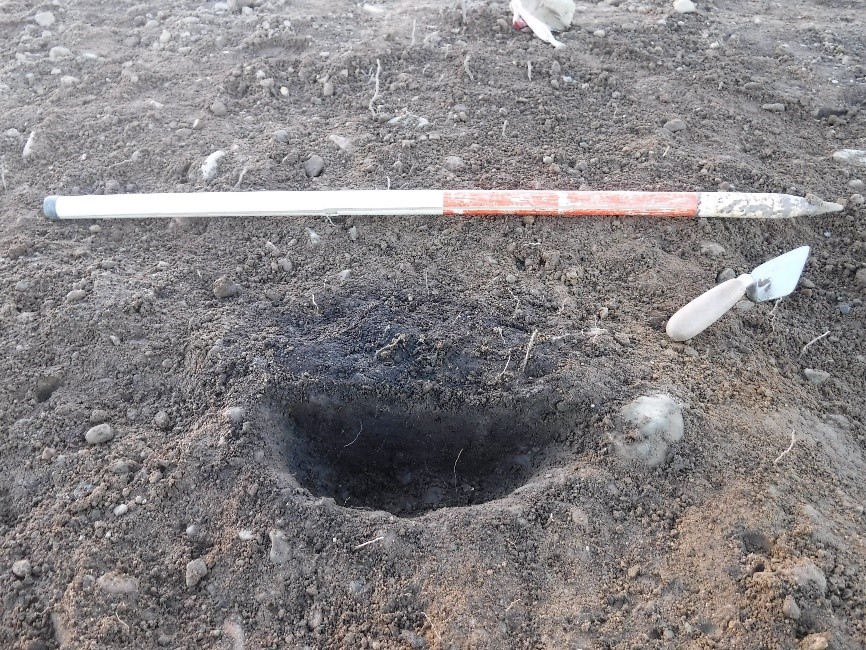
Archaeological Area 1 comprised eight pits, five of which contained token deposits of burnt bone and one composed mainly of scorched sand. Two shallow deposits with burnt bone flecks recorded within a natural hollow and a possible post-hole were also within this area. The area was located on the top of the slope of the hill on the south-west edge of site. The pits without cremated deposits were clustered to the east of AA 1 with the token burnt bone deposits noted throughout the site but were generally focused on the west end. The pits and post-hole without burnt bone fragments ranged in size from 0.31m x 0.2m x 0.14m, the smallest, to 0.5m x 0.34m x 0.18m the largest. The sub-circular pits with burnt bone fragments ranged in size from 0.48m x 0.4m x 0.25m, the smallest, to 0.54m x 0.43m x 0.15m the largest. An oval pit filled with scorched sand and burnt bone flecks was also noted, cut by a cremation pit. It measured 1.45m x 0.9m x 0.18m.
Archaeological Area 4 consisted of two pits. The first pit (1.6m x 1.2m x 0.12m) was filled with charcoal-stained sandy clay and the second (2.6m x 0.95m x 0.31m) was filled with black-brown silty sand and stone deposit from which a flint scraper was recovered. A modern sub-oval cut contained a dark brown gravelly deposit with a piece of modern glass. A single post-hole was noted to the south-west of the pit.