1998:248 - GALWAY: Flood Street/New Dock Street, Galway
County: Galway
Site name: GALWAY: Flood Street/New Dock Street
Sites and Monuments Record No.: N/A
Licence number: 97E0377
Author: Fiona Rooney, Archaeological Consultancy
Author/Organisation Address: Ballydavid South, Athenry, Co. Galway
Site type: Town defences
Period/Dating: Late Medieval (AD 1100-AD 1599)
ITM: E 529778m, N 724973m
Latitude, Longitude (decimal degrees): 53.270447, -9.052734
The site at Flood Street/New Dock Street lies inside the town walls of Galway and falls within the zone of archaeological potential as depicted in the Urban Archaeological Survey.
Pre-development testing in the form of trial-trenches was undertaken, and numerous wall foundations and cobble levels of possible archaeological significance were revealed. Based on these findings, it was recommended by Dúchas The Heritage Service that full excavation be carried out in the areas where there was a high concentration of piles.
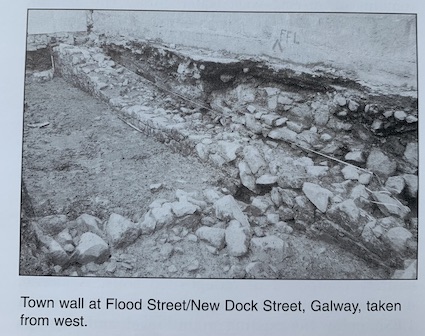
The excavation revealed a number of archaeological features, the remains of the town wall along the south-east boundary of the site being the most significant. The area where the wall was revealed was excavated to a depth of 1.3m. It was constructed of roughly coursed limestone masonry, with a solid core of rubble and mortar. The wall sloped from a maximum height of 1m at the north-east to 0.5m at the south-west. It was 1.24m wide, although it is likely to have extended further below the wall of the adjacent building.
Abutting this wall the foundations of a further wall were revealed, which may have represented a medieval/post-medieval structure. The town wall and the associated features, foundation walls and cobble surfaces, were not fully excavated as consultations with Dúchas The Heritage Service resulted in the foundation layout being changed to facilitate the archaeological features uncovered. A 300mm buffer zone comprising a layer of terram, covered with hard-core, was placed between the bottom of the ground-beam and the ground surface, to facilitate preservation in situ.