
2026:204 - The Moy Graveyard, Summerhill Demesne, Meath
County: Meath
Site name: The Moy Graveyard, Summerhill Demesne
Sites and Monuments Record No.: ME043-031001
Licence number: 25E0790
Author: Niall Roycroft
Author/Organisation Address: c/o Meath County Council, Buvinda House, Dublin Road, Navan, Co Meath. C15 Y291.
Site type: Graveyard
Period/Dating: Modern (AD 1750-AD 2000)
ITM: E 683216m, N 747448m
Latitude, Longitude (decimal degrees): 53.470492, -6.746589
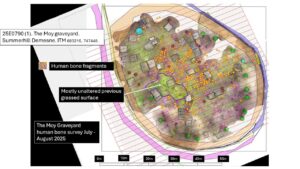
Unauthorized vegetation clearance, topsoil disturbance and headstone straightening works occurred at The Moy Graveyard, RMP ME043-031001, in Summerhill Demesne townland in May-June 2025. The unauthorized works focussed on the central area of the site which had been cleared of all shrubby and small tree vegetation, as well as having any burial mounds levelled. Thirteen larger trees had also been felled, but their root boles had been left in situ. The overgrown yew trees lining the loop path had been lopped extensively but had been left in situ.
The exposed ground had been raked flat by machine and all the field stones had been removed and dumped into the looped path. The main area of the site was then left with a relatively clean topsoil (i.e. suitable for lawn mowing) with many broken human bones in it. The stoney-filled looped path had been tracked/run over many times to consolidate it, but works were halted before imported chippings (an apparent intention of the unauthorized works) could be brought in.
Following an inspection National Monuments Service recommended that a Section 26 Licence be obtained for the collection and analysis of these human remains, in consultation with the National Museum of Ireland, and with a named Osteo-archaeologist. A site survey of other features was also recommended.
The Moy Graveyard (with its now-erased Chapel of Ease ME043-031) has no known records prior to the 17th century and it is assumed that the whole graveyard population dates from the 17th – 20th century. The graveyard contains many 18th-century headstones, numerous large, uninscribed stone grave markers (including a few architectural fragments perhaps from the Chapel of Ease) and many very modern graves (often probably enlarged from an original single or ‘family’ plot).
In August 2025, the human bone was collected in defined survey areas. Three large spoil heaps – each slightly over 1 ton/0.8 cubic metres of soil – were also sorted by hand and any human bone recovered. The sorted spoil heap soils were raked for stones and the earth was spread out on site so that the existing grass cover would grow up through it.
The human bone amounted to around 310 fragments weighing 2.4kg. The bones came from juveniles and adults and were almost all fragmented to a similar small size with both old and new breaks. Some animal bones were also noted. In addition to the bones, a small, post-1910 aluminium/tin scapular medal that had presumably been once located on a now-disturbed grave, was noted.
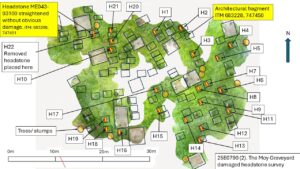
Around 37 headstones had been straightened using a mechanical excavator and a strap. Twenty-two damaged headstones were numbered H1 to H22. H1 and H2 were broken and had been glued back together, but it seems this work took place pre-2025. H3 to H21 had all been either chipped, scratched or both with the digger bucket. Headstone H22 had been fully removed from the ground and dumped on a nearby grave. Headstone RMP ME043-031002 had been straightened but did not appear to have been damaged.
Perhaps 50 or so headstones had also been unsympathetically and patchily cleaned with bleach. These were all mapped and photographed.