
2026:202 - Rathmore Abbey, Meath
County: Meath
Site name: Rathmore Abbey
Sites and Monuments Record No.: ME024-017001
Licence number: E005110
Author: Niall Roycroft
Author/Organisation Address: c/o Meath County Council, Buvinda House, Dublin Road, Navan, Co Meath. C15 Y291.
Site type: Graveyard
Period/Dating: Modern (AD 1750-AD 2000)
ITM: E 674538m, N 766547m
Latitude, Longitude (decimal degrees): 53.643394, -6.872716
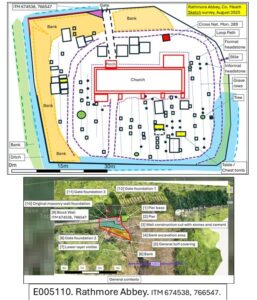
The works were to install a new, steel, stockproof kissing gate 1.5m wide adjacent to the historic (probably 19th-century) main entrance to the graveyard. This meant the removal of a 2.2m section of 1950’s concrete blockwork boundary wall of Rathmore Graveyard, RMP ME024-017001, which forms part of National Monument No. 289 in Rathmore townland. Works took place on 25 July 2025.
Inside the 1950’s wall was a very large, embanked heap of earth. This may have originated from excavation of the church interior and surrounding areas, where a general ground reduction probably accompanied the conservation works completed on the ruins in the 1930s, or at an even earlier date.
The 2025 excavations were roughly 0.33 sq. m of the bank (between 0.1m and 0.5m high), 0.45 sq. m (between 0.3m to 0.55m high) of the 1950’s wall construction cut and 0.29 sq. m of 1950’s wall removal. The lowest course of the 1950’s wall was left in situ, apart from a new gate post that was dug down 0.45m through the original masonry wall foundation.
The Rathmore graveyard post-medieval boundary wall seems to have been built in an earlier boundary ditch that surrounds the whole graveyard. The second new gate post-hole (0.2m diameter x 0.6m deep) was sunk into probable graveyard soils and the third was sunk into the boundary ditch backfill. The new gate was not attached to the original, monolithic, octagonal, granite, gate piers.
Unstratified finds from the upcast bank and 1950’s construction cut backfill comprised:
- A clay tobacco pipe bowl stamped ‘Browns Cutty’, which probably relates to the Brown pipe manufacturers in Dublin of the 1870s-1880s and might date the creation of the internal bank or be discarded waste from a graveyard visitor.
- Six fragments of grey-green roof slates that may have come from Rathmore Abbey.
- Two large animal bones (a cow tooth and a rib).
- Very modern grave ornament fragments such as quartz chippings, vase and bottle glass and some modern pottery.
- Agricultural remains of barbed wire fragments, fencing wire, electric fencing wire and a large nail (100mm long, squared head, appears unused, therefore not a coffin nail).
- The previous modern padlock from the graveyard gate was also found; as well as a food tin and a 1 Euro coin.
A total of nine, small, broken human bone fragments were found. All were from disarticulated remains that had already been disturbed when the bank inside the northern boundary wall was created. All were small sized with old breaks. Another eight, very small, comminuted fragments were noted. These bones were all considered to be standard, random human bone remains that are found in all historic graveyards and as such, did not require contacting the NMI or an osteologist.
All of the excavated soil, which had been thoroughly inspected for human bone, was retained on site.