
2026:201 - St Kienan's/St Mary’s Abbey graveyard boundary wall, Duleek, Meath
County: Meath
Site name: St Kienan's/St Mary’s Abbey graveyard boundary wall, Duleek
Sites and Monuments Record No.: ME027-038029
Licence number: E005774
Author: Niall Roycroft
Author/Organisation Address: c/o Meath County Council, Buvinda House, Dublin Road, Navan, Co Meath. C15 Y291.
Site type: Graveyard
Period/Dating: Modern (AD 1750-AD 2000)
ITM: E 704580m, N 768418m
Latitude, Longitude (decimal degrees): 53.655062, -6.417907
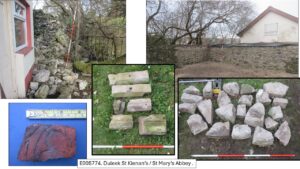
Following a partial collapse of St Kienan’s/St Mary’s Abbey graveyard boundary wall, Duleek Commons, Duleek, ME027-038029 (part of RPS MH027-205/NIAH 14321010) in February 2024, Meath County Council repaired the wall in November-December 2024.
The main collapsed wall section probably dates to the 18th century, since it contains architectural stones robbed from the St Kienan’s/St Mary’s Abbey and/or Church buildings, ME027-038003 + ME027-038013. The wall is around 0.7m thick and ground level externally is around 1m lower than ground level in the graveyard.
The fallen parts of the wall were removed by hand and all worked and potentially worked stones were set aside. The wall was then rebuilt using existing and matching stone and the wall was buttressed on the external side. The works showed that this wall had been extensively repointed in the very recent past. No excavations were required and no human bone (or animal bone) was recovered.
Six stones clearly came from the nearby church and/or church tower. One stone was a decorated, central window mullion, two were sill pieces, two were mullions that are similar to the belfry windows in the church tower and one is a voussoir, a cut, rounded arch piece with moulding similar to that used in St Kienan’s church. In addition, part of a medieval floor tile decorated with a quarter of a rosette motif (four tiles forming a composite rosette with eight lobes) was found reused as building material.
Nine more stones comprised more roughly worked pieces, but all had a distinctive curved face that had been given a pecked finish. The arc on this curve would define a circle around 1.2m in diameter (i.e. too small to be part of a typical round tower). But the stones were around 0.2-0.25m thick and up to 0.4–0.7m wide. Two stones had worn surfaces as if used for a threshold, step or a flight of stairs. Some more stones similar to these were left in situ in the graveyard wall.
A tenth stone was cheese-wedge shaped like an arch springer (rather than a keystone) and had a pecked finish on all sides except the base. This stone also had a distinctive outer curve.
The original location and use of the Duleek arcing stones is not yet known. Similar c.1.2–1.5m diameter circular pedestals are known as font bases – and one of the Duleek stones shows clear wear marks as if frequently walked on – so a circular base is a possibility. All of the stones are being retained on site.
A survey of the graveyard wall’s north-west corner showed many stones that were large enough to have come from the now-lost round tower – which shows as a scar in the main square tower. In addition, the north-west entrance to the graveyard was recorded showing it was actually a folly composite made up of random worked stones from the church – all put together to form an arched entrance gate.