
2025:735 - Binghamstown/An Geata Mor, Ballymacsherron, Cross (Boyd), Cross (Wallace) & Rinneanach Townlands, L-5233, L52364 & L-52361 (Local Roads)., Mayo
County: Mayo
Site name: Binghamstown/An Geata Mor, Ballymacsherron, Cross (Boyd), Cross (Wallace) & Rinneanach Townlands, L-5233, L52364 & L-52361 (Local Roads).
Sites and Monuments Record No.: MA016-004, MA016-005 and MA016-006
Licence number: 25E0709
Author: Richard Gillespie, Mayo County Council
Author/Organisation Address: Mayo National Roads Office, Glenpark House, The Mall, Castlebar, County Mayo
Site type: No archaeology found
Period/Dating: N/A
ITM: E 465503m, N 830828m
Latitude, Longitude (decimal degrees): 54.208690, -10.061852
Blacksod Bay Greenway (Phase 1), Co Mayo – Monitoring
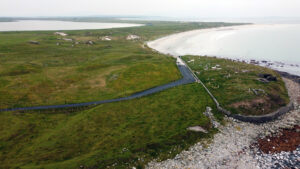
The route goes through the ‘zone of notification’ of three Recorded Monuments but did not directly impact any known archaeological features. The Recorded Monuments are: A Cairn and Burial (MA016-006), a Church and Graveyard (MA016-005) and a graveyard, Religious House, a cross, an ogham stone, headstone and Midden (MA016-004). These are all located in Cross Townland. This existing section of road runs through an archaeologically rich area, where features appear to extend beyond the zones of notification set out in the RMP/SMR. These include three listed RMP sites (MA016-007001-3, MA016-008001-8 and MA009-020001-11) which include about twenty discrete sites in sandhills generally to the north of the greenway route. Groundworks were all confined within the existing road boundaries and there were no external excavation works.
Most of the works involved levelling the pre-existing road surface in advance of resurfacing to upgrade this quiet road and facilitate its shared use incorporating a walking and cycling amenity. This involved occasional planing uneven surfaces to a maximum depth of 250mm of rough or uneven surface and did not reach any undisturbed subsurface strata.
Some limited mechanical excavations were carried out in passing bays, house and field accesses. Surfaces were generally excavated to a depth of less than 200mm with occasional deeper trenches for drainage pipes. Where practical, drainage pipes were placed in the existing open drains and involved minimal new excavation. The stratigraphy exposed in these areas generally consisted of disturbed or ‘made ground’ which provided the foundation for the road or pre-existing entrance features. Occasional modern finds were noted.