2025:631 - Saint Ann’s Court, Englishtown, Limerick City, Limerick
County: Limerick
Site name: Saint Ann’s Court, Englishtown, Limerick City
Sites and Monuments Record No.: LI005-017-----, LI005-017010-;
Licence number: C001010 ext., E005241 ext.
Author: Graeme Laidlaw & Seán Shanahan; Shanarc Archaeology Ltd.
Author/Organisation Address: Unit 39a, Hebron Business Park, Hebron Road, Kildare
Site type: Historic city wall
Period/Dating: Multi-period
ITM: E 557953m, N 657711m
Latitude, Longitude (decimal degrees): 52.668939, -8.621656
Archaeological test-excavation and monitoring were carried out between 19 May and 12 June 2021 in accordance with Ministerial Consent No. C001010 ext. and excavation registration No. E00524 ext. on behalf of Limerick City and County Council in relation to the construction of affordable housing at Saint Ann’s Court, and the adjacent site known as ‘Sonny’s Corner’, in Limerick city.
The site had been previously subject to archaeological test-trenching in 2021 (under the same licence), at which time portions of the historic city wall (LI005-017010-), numerous tanning pits, and other archaeological features were identified (see Excavation Bulletin Entry: 2021:231).
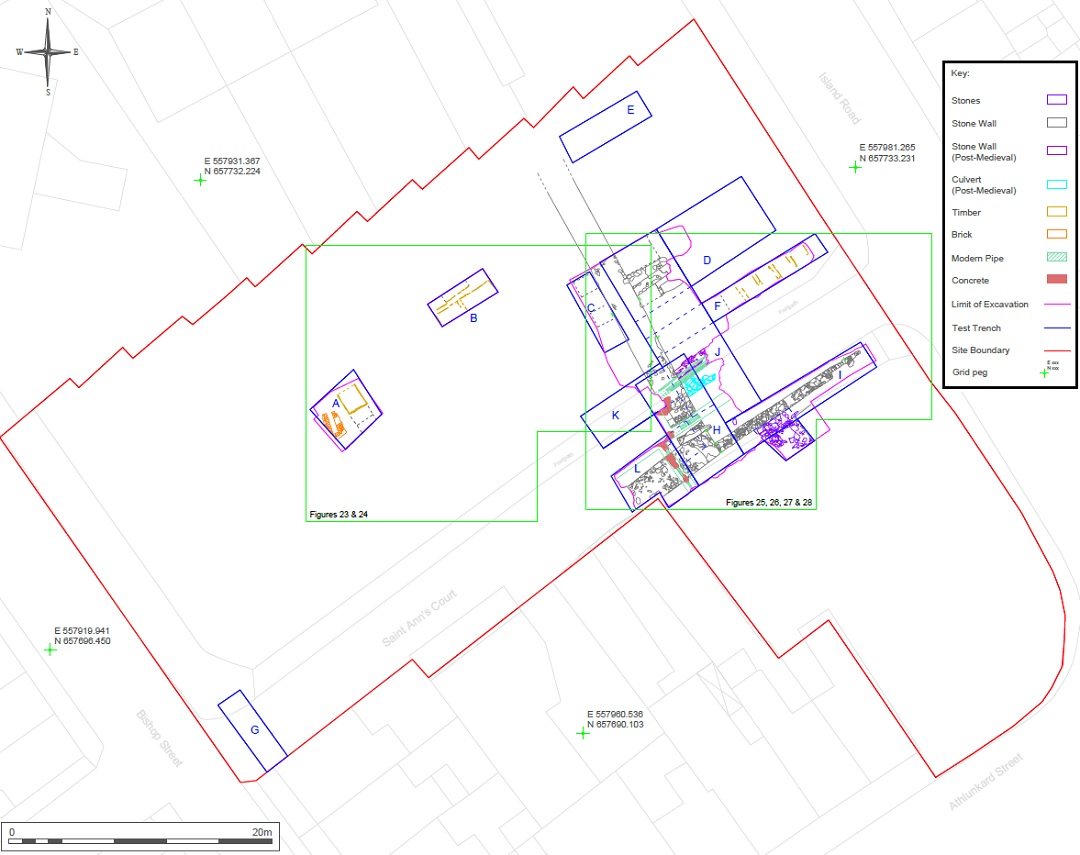
A series of twelve test-trenches were excavated across the Saint Ann’s Court development site and on Saint Ann’s Court (the street) through April and into May 2024. The trenches were labelled from A-L to avoid confusion with the previous round of testing from 2021. The trenches were machine-excavated until archaeological deposits were reached. The archaeological deposits were excavated by hand where possible.
The test excavations exposed a portion of the historic city wall (LI005-017010-), as well as several abutting post-medieval walls. A portion of the former Franciscan friary wall which abutted the city wall was also identified. Evidence of 18th-19th-century tanning pits, and culverts were also identified.
Very few artefacts were recovered from the excavation, the finds were generally post-medieval in date, with the exception of a single glazed floor tile of late medieval date. The ceramic assemblage dated from the late 16th–19th centuries (Kenny 2024). The small assemblage of animal bone appeared to show the ‘local slaughter and consumption of animals’ with some evidence of ‘marrow extraction’ (McCarthy 2024).
Following the test-excavations, archaeological monitoring of geotechnical site investigations was undertaken between 10 and 24 January 2025. Monitored geotechnical works comprised seven boreholes, eight trial-pits, and six slit-trenches.
No archaeological features or artefacts were identified during excavation of any of the trial pits or slit trenches.