
2025:541 - Ballygrennan, Limerick
County: Limerick
Site name: Ballygrennan
Sites and Monuments Record No.: N/A
Licence number: 25E0221 ext.
Author: John Channing
Author/Organisation Address: c/o Archaeological Management Solutions Ltd, Fahy’s Road, Kilrush, Co. Clare. V15 C780
Site type: Burnt mound/fulacht fia
Period/Dating: Bronze Age (2200 BC-801 BC)
ITM: E 555654m, N 659524m
Latitude, Longitude (decimal degrees): 52.685050, -8.655888
Archaeological Management Solutions (AMS) were engaged to undertake archaeological testing, geophysical survey and excavation in fulfilment of a condition of planning permission. The site contained no Recorded Monuments/recorded archaeological sites or sites of architectural heritage interest. The geophysical survey undertaken by Jeff O’Neill of AMS in 2024 (Licence Ref.: 24R0496), identified multiple anomalies which were ‘ground-truthed’ during testing, but all proved to be non-archaeological in origin; however, a burnt mound/fulacht fia site was uncovered during testing comprising an oval burnt spread. The spread lay beneath an original topsoil sealed by later redeposited subsoil and boulders up to 1.5m deep and was situated near an area of wetland that is prone to flooding.
Excavation of the burnt spread revealed a reniform-shaped spread skirting the edge of the water table along its north-eastern (long) side.
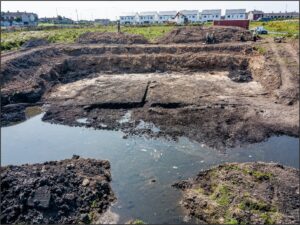
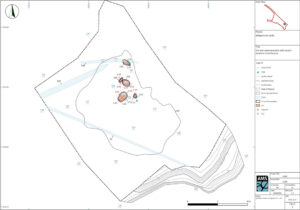
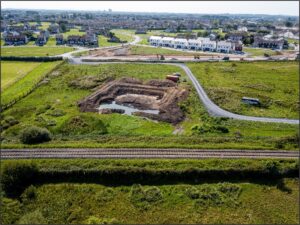
The deposit was thickest at the centre gradually sloping down and petering out around the edges. It was comprised of heat-desiccated sandstone with occasional limestone and sand in a black silt matrix. The stones averaged 0.04m x 0.04m x 0.03m in size, were randomly sorted and accounted for >85% vol. of the deposit. Occasional irregular limestone inclusions were present along the edge of the water table, on the north-east side of the deposit. The deposit was sealed by an earlier topsoil horizon, which was sealed by redeposited subsoil and finally by topsoil.
Excavation revealed the mound measured 17.3m in length (northwest–southeast), 11.4m in width and 0.1–0.45m in depth, thickest in the centre. The natural subsoil beneath the mound sloped down to the northeast and to wetlands, the slope increasing as the level reduced; this was reflected in the topography of the mound.
Removal of the burnt spread revealed the presence of two shallow sub-rectangular troughs and three shallow sub-oval pits. All contained fill very similar to the sealing burnt mound deposit.
Two finds were recovered, representing a broken polished stone (shale) axehead and clay pipe stem fragments. This will be sent for specialist analysis.