2025:569 - Callan South, Mill Street, Callan, Kilkenny
County: Kilkenny
Site name: Callan South, Mill Street, Callan
Sites and Monuments Record No.: N/A
Licence number: 25E0573
Author: Alan Hawkes (for Gregory Archaeology)
Author/Organisation Address: 6 Endsleigh Estate, Carrigaline, Cork
Site type: Medieval/post-medieval
Period/Dating: Late Medieval (AD 1100-AD 1599)
ITM: E 641518m, N 643777m
Latitude, Longitude (decimal degrees): 52.543747, -7.387913
Archaeological excavation was carried out during the early stages of a housing development at Mill Street, Callan, Co. Kilkenny. The site lies in a protected archaeological area, close to medieval remains including St Mary’s Church and graveyard, and forms part of former medieval burgage plots. Earlier investigations (2004, 2019, 2020) had already revealed significant remains in Area A, including a medieval boundary ditch and a cobbled laneway. The most recent monitoring and metal detecting in 2025 confirmed and added to these findings with the discovery of a second medieval ditch, a possible limekiln and a number of other post-medieval drains.
The excavation uncovered two linear ditches (C.006 and C.010) aligned north to south and positioned circa 5m apart. Ditch (C.010), was considerably wider, particularly at the northern end. Both features contained 13th-century pottery preliminarily identified as Leinster Cooking Ware vessels. This pottery was retrieved from basal layers that accumulated from natural silting when the features were open. The only other medieval features uncovered were two pits (C.030 and C.079), both of which contained similar pottery.
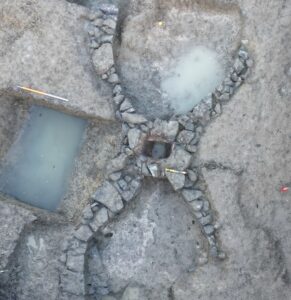
Both ditches were overlain with the foundations of limekilns, one of which was two-phased (Kiln 2 and 3) and built within the upper fill of the larger medieval ditch (C.010). This kiln was found during the current phase of excavation works. The recovery of medieval pottery from the walls between these two kilns may indicate an early origin for the construction of these two structures. The other Limekiln (Kiln 1), partially overlay the eastern ditch (C.006). Only the foundations survived, however, it was in better condition, with the other kilns slumping eastwards into the softer underlying fills of the ditch (C.010)
The remaining post-medieval/early modern features uncovered included three possible drains (C.027, C.060 and C.065), a possible tree-bowl (C.024) and a number of agricultural furrows. A 7m-length of cobble surface (C.066), initially discovered during the 2004 testing, was uncovered at the north-western corner of Area A and was aligned with the original entrance to the site. This surface may have provided access to the later industrial activity at the site.
A considerable quantity of metal items were uncovered during the continued metal detecting of the remaining topsoil. The vast majority was identified as modern ferrous material, however, several medieval and post-medieval coins were found, including a 16th-century Elizabeth 1st silver sixpence, a 14th-century French Jetton, a 17th-century silver Commonwealth Half Groat and a 13th-century Alexander III silver coin. Other notable finds including two lead musket balls, several buckles, and a large number of copper alloy buttons, several of which appear to be military in origin.
The discoveries show that the site retains important traces of medieval Callan, particularly two 13th-century ditches that may relate to an earlier circuit of the town defences, prior to the construction of any stone equivalent. Their size, depth and relative spacing would appear to negate their function as property boundaries. Added to this is the evidence for possible clay banks on their eastern sides. The ditches were backfilled sometime during the High Medieval period, at a time when the town was undertaking considerable construction, evidenced by the discovery of several limekilns on the site which appear to be medieval in origin. This is based on the recovery of stratified material culture. The kilns possibly operated in the production of lime for building purposes, possibly for the construction of stone buildings and even the town walls.
Post-excavation and analysis is ongoing.