2025:227 - DÚN AILINNE, Kildare
County: Kildare
Site name: DÚN AILINNE
Sites and Monuments Record No.: KD028-038
Licence number: E0004689
Author: Susan A. Johnston, George Washington University
Author/Organisation Address: 14111 Westholme Ct., Bowie, MD 20715 USA
Site type: Ceremonial enclosure
Period/Dating: Multi-period
ITM: E 681962m, N 707912m
Latitude, Longitude (decimal degrees): 53.115462, -6.775661
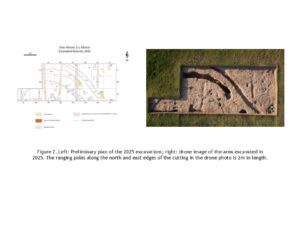
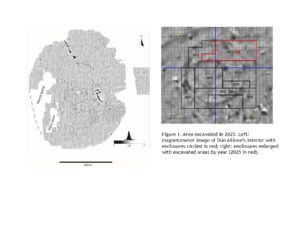
A four-week field school excavation was carried out at Dún Ailinne, Co. Kildare, from June 16-July 11, 2025, completing the excavation of a series of ditched enclosures begun in 2018. Two of these were identified through a magnetometer survey (2006-2008). Both are circular and intersect (Fig. 1), the one to the north larger than the one to the south (21m versus 16m maximum diameter, respectively). A third enclosure (14m diameter) was identified in 2023, located in the same space but underlying both the northern and southern enclosures. All three are located within a large enclosure that rings the summit of the hill (identified through magnetometer survey and explored through excavation in 2016) but are about 50m to the north-northwest of the Iron Age timber structures identified in earlier excavations (1968-1975).
In this season, our primary goals were: 1) to complete the excavation of the three enclosures we have been investigating since 2018; 2) to acquire additional material for radiocarbon dating from all features encountered, but particularly the earlier enclosure; and 3) to trace the continuation of the earlier enclosure and finalize its extent and character. To pursue these goals, we opened an area immediately to the north of the cutting excavated in 2024 (Fig. 2), encountering 46 archaeological features. These included the ditches of the three enclosures and their various recuts, a number of pits, post- and stake-holes, and a series of plough furrows.
The ditches that comprise two of the enclosures were largely the same in this season as they were in previous seasons. The inner and outer ditches of the double-ditched northern enclosure both appear to have been dug and then recut, and the inner ditch was cut into bedrock. As seen previously, the outer ditch of the northern enclosure was shallower than the inner. Interestingly, there is a clear entrance feature through the inner ditch to the northeast, directly opposite to the entrance at the southwest, documented in 2021. However, there is no corresponding gap in the outer ditch at the northeast, though the latter does curve inwards where it passes the inner ditch gap. The single ditch of the southern enclosure was also encountered, largely in section, where it barely grazed the southern baulk of the cutting in J9 and K9. Finally, the earlier enclosure, identified in 2023, was also encountered running through the cutting. This structure, which is extremely shallow compared to the other two, continued on its arc through the cutting, but unlike last season, no stake-holes were encountered. These features would appear to have been confined to the entrance of that structure.
Nothing encountered in this season changes our interpretation of these enclosures relative to those from the earlier excavations—the sequence of these smaller structures mirrors those on the summit, becoming larger and more elaborate over time. It is unclear if the earliest enclosure was always shallower and irregular or if this is a function of preservation, but it was certainly the smallest. This was followed by the larger and apparently deeper southern enclosure, and finally the northern enclosure, which is the most elaborate. Each of the latter two was also recut at least once, and possibly multiple times, indicating continued interest in modifying these structures. Whether this sequence reflects continual rebuilding of different versions of the same monument or instead represents three discrete phases of the use of this area is uncertain. The entrance going through the inner ditch but not through the outer may be understood in a number of different ways. It may support the idea that this monument was constructed in separate phases, with the outer being added later and the inner not closed for practical or symbolic reasons (or both). Alternatively, this had some other function, possibly funneling movement through this feature, for example, allowing movement through the entrance at the southwest and then moving between the ditches, then into the inner area through the gap to the northeast.
In addition to the enclosures, we excavated seven plough furrows, several clay deposits and a number of other pits, post- and stakeholes. Apart from two post-holes that were located in the gap that forms the entrance to the inner ditch of the northern enclosure, the rest of the stake and post-holes did not form any obvious patterns. While their dates are unknown, at least some of them are presumably related to the construction, reconstruction, maintenance and/or use of the enclosure ditches. As in previous years, clay deposits were encountered, three on the surface of the inner and outer ditches and one other located well outside of the outer ditch of the northern enclosure. As with the other features, these may have something to do with the construction or maintenance of the ditches, or they may have been created when the ditches were formally closed.
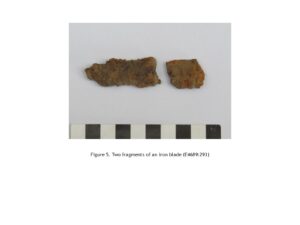
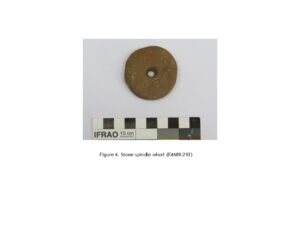
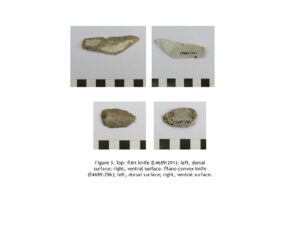
As is typical at Dún Ailinne, few artifacts were recovered from the features excavated. There were nine in total, six of them lithics, including two flint knives (E4689:291 and E4689:296, the latter plano-convex; Fig. 3) and a domed scraper. A stone spindle whorl (E4689:292), was recovered from the plough soil (Fig. 4). Two iron objects were also recovered. One of them was also from the plough soil (E4689:290) and is almost certainly modern (Fig. 4), while the other (E4689:293) was an iron knife blade in two fragments, recovered from the outer ditch of the northern enclosure (Fig. 5). In addition to these artifacts, both burned and unburned bone, including a cattle tooth (E4689:302), was recovered from several contexts. With a few exceptions, these could not be identified as to species, and while it is likely that it is non-human animal, the possibility of human remains cannot be ruled out. Several samples were collected in case further analysis of this material becomes possible. Charcoal was also collected from three contexts to be submitted for radiocarbon analysis following species identification.
All artifacts and samples are now in the National Museum.