2025:392 - DART + COASTAL NORTH PROJECT, Co. Dublin & Co. Meath, Dublin
County: Dublin
Site name: DART + COASTAL NORTH PROJECT, Co. Dublin & Co. Meath
Sites and Monuments Record No.: N/A
Licence number: 25E0280
Author: Thaddeus C. Breen; Shanarc Archaeology Ltd.
Author/Organisation Address: Unit 39A, Hebron Business Park, Hebron Road, Kilkenny
Site type: No archaeology found
Period/Dating: N/A
ITM: E 721429m, N 762612m
Latitude, Longitude (decimal degrees): 53.599275, -6.165411
Archaeological test-excavations were carried out from 7 to 15 April 2025, in association with the DART + Coastal North Project. Test-excavations were carried out in tandem with a metal detection survey of the topsoil excavated from trenches under detection device licence 25R0131.
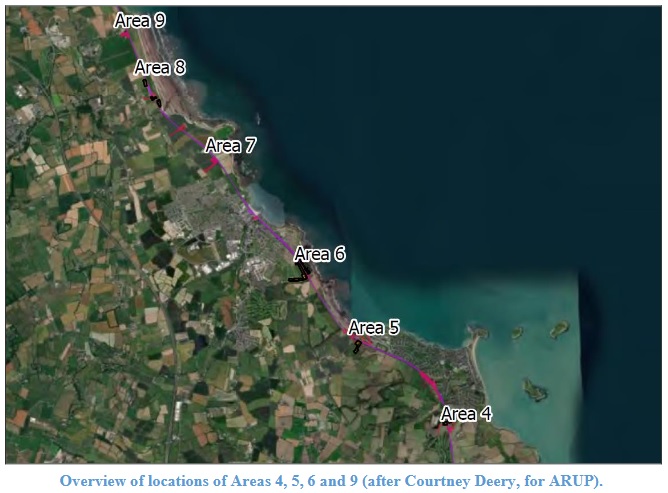
12 off-track areas (Areas 1-12) of archaeological potential along the existing rail line were identified by Courtney Deery Heritage Consultancy Ltd. for test excavation, on behalf of ARUP. The identification of these areas was partly based on the results of a geophysical survey by J. M Leigh Surveys Ltd. carried out under multiple detection device licences (licence nos. 23R0476-23R0489; 23R0536) in 2023. Due to access constraints, the proposed trenches in several areas were descoped from the contract. This was agreed with Arup, the client’s representative for the works. Four of the originally proposed areas (Areas 4, 5, 6 and 9) were subjected to archaeological testing. Of these, Areas 5 and 6 were previously subjected to geophysical survey, and the test trench array targeted the identified anomalies.
Areas 4 and 5 were on the outskirts of Skerries, Co. Dublin (to the south-east and north-west sides respectively). Area 6 was on the south-east outskirts of Balbriggan, Co. Dublin. Area 9 was to the north-east of Gormanstown, Co. Meath, at Gormanstown Army Camp.
A total of thirty test-trenches were excavated across the four locations. The only features identified were two French drains of modern date (Area 4, Trench 2; Area 5, Trench 6), a modern field boundary (Area 6, Trench 4) and a plastic waterpipe (Area 5, Trenches 1, 3, 4).
Numerous metal objects, in addition to ceramic and glass objects, were identified during the metal detection survey and during visual examination of the excavated topsoil. Most of the objects were modern, including a number of bullet casings and an Air Corps badge in Area 9, connected with Gormanstown Army Camp, but one definite antiquity was a lead spindle whorl (Area 4, Trench 3) similar to those found in Viking period deposits in Dublin city.
Thirty-six metal objects, inclusive of the lead spindle whorl, were retrieved from Area 4 and assessed by metal specialist Órla Scully, who identified the metal assemblage from Area 4 as being largely post-medieval/early modern; though, with with two objects confirmed as high priority objects to be deposited with the National Museum of Ireland—a medieval Type 2 lead spindle whorl (25E280:1:36) and an undatable fragment of a possible copper alloy vessel (25E280:1:20).