2025:264 - BALLYCANNON (Kerrypike), Cork
County: Cork
Site name: BALLYCANNON (Kerrypike)
Sites and Monuments Record No.: N/A
Licence number: 25E0114
Author: Alan Hawkes
Author/Organisation Address: 6 Endsleigh Estate, Carrigaline, Cork
Site type: Fulacht fia
Period/Dating: Bronze Age (2200 BC-801 BC)
ITM: E 560603m, N 573468m
Latitude, Longitude (decimal degrees): 51.911955, -8.572631
The previously unknown site was uncovered during pre-development test-trenching in late 2024 (Carroll 2024; 24E1034X). The testing was undertaken by Tobar Archaeological Services on foot of planning permission issued by Cork City Council, for a new residential and commercial development.
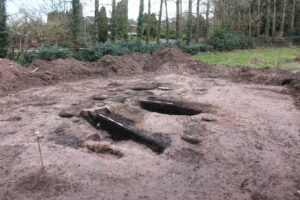
The seemingly ploughed-out remains of a burnt mound were partially uncovered in one of the test-trenches (Tr.22) at the south-west side of the site. The mound material was not fully exposed, with the visible remains in the trench measuring 5.8m north-south x 2.6m. Some additional possible cut features were also noted. Archaeological excavation was carried out by Hawkes Archaeological Services over two weeks in late Feb/early March 2025, under licence (25E0114).
During the course of excavation, two phases of prehistoric activity were revealed beneath a thin spread of heat-shattered stone (C.04) mixed with ploughsoil. The first contained the remains of a substantial circular trough (C.21) with an adjacent hearth (C.07) defined by an area of oxidised soil. A second phase of activity was associated with a large irregular pit (C.13) that cut the earlier hearth. A curving drain or slot trench (C.24) can also be assigned to this phase. Re-deposited substratum (C.09 and C.08) was present throughout much of the north-western side of the main features, deposited here from the original excavation of the pits. All cut features were backfilled with burnt mound material that filled the upper horizons of each pit. Later disturbance in the form of two linear hand-dug agricultural furrows cut through the site running north-south direction while a number of modern plough scars were also recorded. Samples have been retained for environmental analysis and radiocarbon dating.