
2025:178 - DISERT: Disert Graveyard, Donegal
County: Donegal
Site name: DISERT: Disert Graveyard
Sites and Monuments Record No.: DG084-001
Licence number: 19E0150 ext.
Author: Fiona Beglane
Author/Organisation Address: School of Science, ATU Sligo, Ash Lane, Sligo
Site type: Ecclesiastical site
Period/Dating: Multi-period
ITM: E 587942m, N 887292m
Latitude, Longitude (decimal degrees): 54.733529, -8.187219
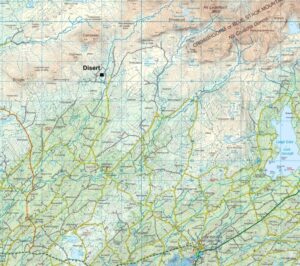
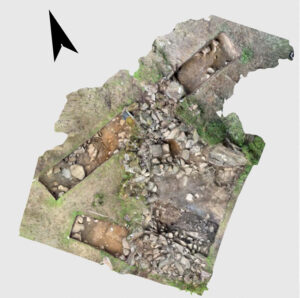
Disert, Co. Donegal, is a multi-period archaeological landscape. To date, evidence for activity was uncovered on the site ranging from the prehistoric period through to the nineteenth and twentieth centuries. 2024 was the fourth and final season of excavation and focused on understanding the features making up the enigmatic ‘arch enclosure’ at the eastern limit of the site, which had previously been interpreted as a megalithic tomb, and more recently as a potential monastic cell or sheepfold.
It is clear from the stratigraphic sequences developed that the western side of the ‘arch enclosure’ post-dates the ecclesiastical bank and internal ditch. As such, the interpretation of this enclosure as a megalithic tomb can be discounted. Instead, a complex picture emerges.
A substantial sub-rectangular stone structure lay just outside the ecclesiastical bank and appears to have been a central focus of activity. Initially thought to be a wall, the structure is extremely substantial and well-built, measuring c.2m by 1-1.2m, and constructed on a plinth. Its purpose is unclear, however one possibility is that it may have functioned as an altar or leacht outside the ecclesiastical enclosure. In support of this, a possible grinding stone or penitential stone, similar to those found on the known altar at the central graveyard at Disert (Beglane et al. 2018a), was recovered from the upper surface of the structure. A blue glass bead was recovered from a deposit immediately adjacent to, and post-dating the structure, so this may hint at an early medieval date for activities in this area. Radiocarbon dating of the deposits immediately to the northwest and respecting the structure should provide a terminus ante quem for the structure.
A stony bank that runs north-south from the unexcavated line of the ecclesiastical enclosure to the arch enclosure is likely to post-date the ecclesiastical bank, and also post-dates occupation/activity levels in Trench 7. The presence of a quern stone in these activity levels may indicate an early medieval date for these activities. Again, radiocarbon dating should provide a terminus post quem for this wall and a direct date for the occupation/activity level itself.
A newly discovered penitential station was built up against the boundaries of the enclosure and post-dates these features. It is not dissimilar in form to the free-standing platforms found within the cairns previously excavated in Trenches 3 and 5 (Beglane et al. 2022), which date to the late-medieval/post-medieval transition and the post-medieval/modern period (D-AMS051766 and D-AMS051765).
Excavation is now complete and full post-excavation analysis is underway.
References
Beglane, F, Bonsall, J, Moran, J, Nugent, L & Meehan, H 2018a, ‘An oasis in the desert: the early ecclesiastical site of Disert, Co. Donegal’, Journal of Irish Archaeology 27: 57-79.
Beglane, F, Donham, M, Eddards, K, Lowry, M and Towler, M 2022, Preliminary report on June/July excavation at Disert, Co. Donegal DG084-001. Licence No. 19E0150 (Extension). Unpublished report submitted to the National Monuments Service.