
2024:862 - Park South, Midleton, Cork
County: Cork
Site name: Park South, Midleton
Sites and Monuments Record No.: NA
Licence number: 23E0544
Author: Avril Purcell
Author/Organisation Address: Lane Purcell Archaeology, 64 Fr Mathew Rd, Turner's Cross, Cork
Site type: Circular structure, pits, post-holes & burnt spread
Period/Dating: Multi-period
ITM: E 589400m, N 573600m
Latitude, Longitude (decimal degrees): 51.914434, -8.154078
Potential archaeological features were identified in three areas during pre-development archaeological testing of the site in 2023; two of these, both towards the central eastern area of the site, proved upon excavated to be of little archaeological significance. The features identified were largely derived from agricultural activity and animal burrowing with a pit containing 19th-century brick and slate also present.
Significant archaeological deposits were identified in the third location on a sandy gravelly hill at the north of the site close to the Dungourney River. The site was truncated by furrows and extensive rabbit burrowing of the very sandy subsoil. A discontinuous portion of slot trench meandered for almost 50m across the low crest of the hill, extending downslope to the northwest, approaching the river. A piece of struck flint was found in the slot trench and sherds of prehistoric pottery were found in a pit cutting the trench providing a terminus ante quem for its use. Over 20 post- and stake-holes were within or associated with the slot trench suggesting it supported a palisade fence.
Approximately 10m west of the meandering slot trench a circular structure was identified defined by an annular slot trench with an internal diameter of 8m. Internal features identified included post-holes, stake-holes, pits and occasional spreads but no hearth or evidence of in-situ burning was identified. Eight post-holes and six possible post-holes were identified in the slot trench but the loose sandy gravelly nature of the subsoil made the identification of some of these features very difficult. Two pieces of flint were found in the fill of the slot trench.
The southwestern side of the slot trench was cut by a ditch. The ditch was in two parts with a gap between the section close to its truncation of the circular structure. The ditch was almost 40m long oriented north-west/south-east. It was cut by a farm track at the south-east end and petered out at the northwest as it extended into lower ground.
At the east of the site a large number of pits and post-holes were identified as well as a small number of small slot trenches. Prehistoric pottery sherds were found in a small number of the pits as well as occasional pieces of struck flint. Two slag pit furnaces were found at the eastern edge and parts of probably post-medieval shallow ditches were identified which may relate to now-removed field boundaries.
Approximately 200m to the southwest a heavily truncated burnt spread was identified measuring 12m by 7m. It was cut by three irregular shallow pits and several possible post-holes. No finds were identified.
Archaeological excavation was undertaken from February to May with intermittent monitoring continuing until November 2024 in advance of the construction of a distillery. No additional archaeological sites were identified during archaeological monitoring.
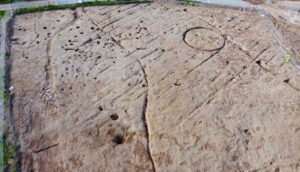
Post-excavation view of site, looking south.