2024:170 - CAHERCONNELL, Clare
County: Clare
Site name: CAHERCONNELL
Sites and Monuments Record No.: CL009-030008
Licence number: 22E0386
Author: Michelle Comber
Author/Organisation Address: Archaeology, University of Galway
Site type: Ringfort - cashel
Period/Dating: Multi-period
ITM: E 523553m, N 699437m
Latitude, Longitude (decimal degrees): 53.040127, -9.139951
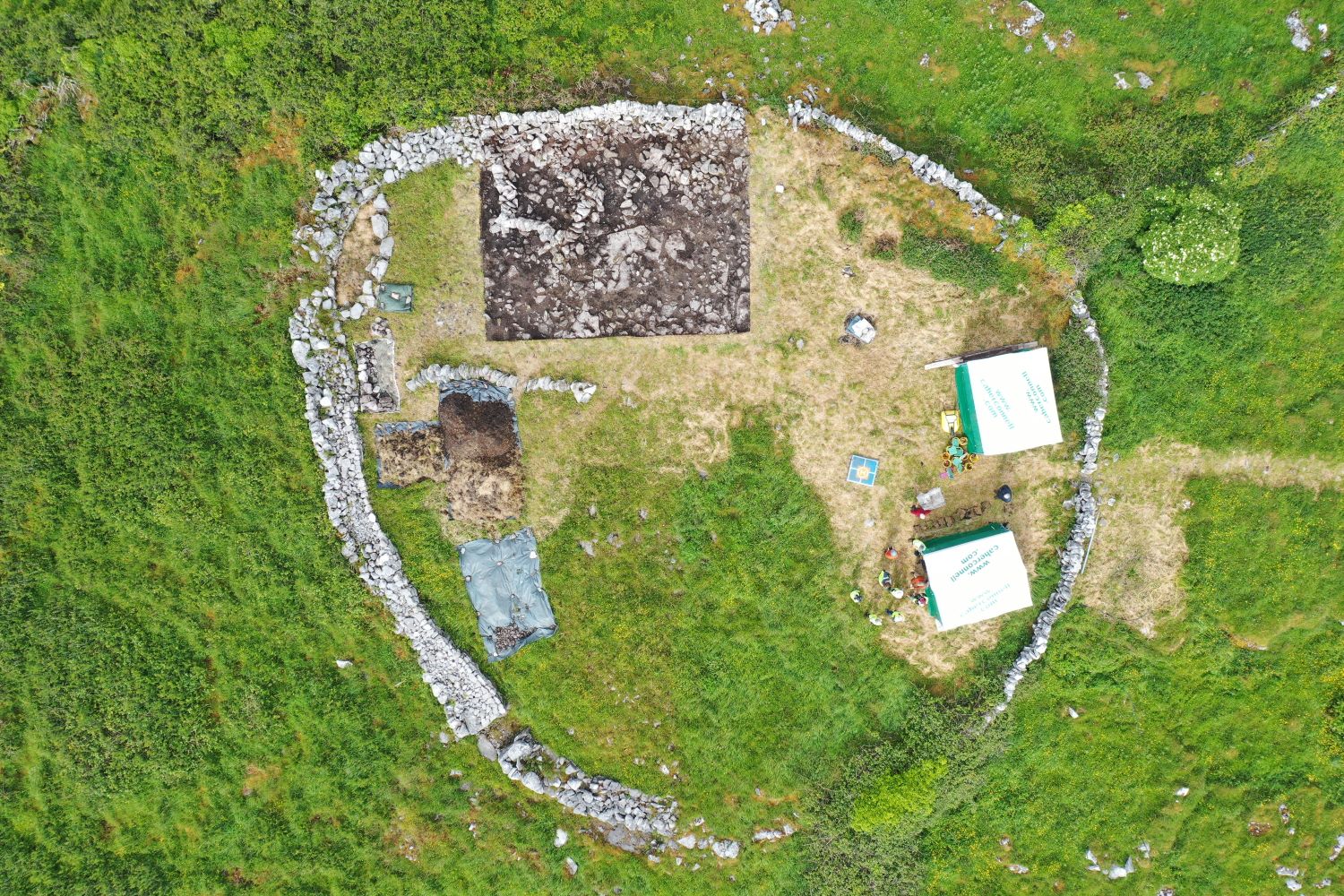
Four drystone enclosures or cashels occur in the townland of Caherconnell in the Burren, Co. Clare. Two have already been excavated (10E119 and 10E0087), with this example situated between these two. The cashel is sub-circular and now defined by a collapsed drystone wall of 35m maximum external diameter. Much of the stone from the cashel wall has clearly been removed and ‘recycled’, for use either in later enclosures or field walls. Its entrance faces southeast. Excavation is by the Caherconnell Archaeology Field School.
The 2024 primary target (Cutting C) was a cutting located in the western half of the cashel interior. It was designed to explore the cashel interior and a visible, potentially late, hut-like structure. It measured 12m north-south by approximately 8m (up to the inner face of the cashel wall). The cutting was extended 6m to the north (the extension referred to as Cutting C.1), while Cutting D comprised a 6m x 8m excavation across the northern of two substantial field walls that extend westwards from the exterior of the cashel wall.
Ten main archaeological phases have been identified. These phases date to the Early Bronze Age, c.2210 BC, as-yet undated ‘pre-cashel’, Early Medieval (c.800 AD), Medieval, Post-medieval, Early Modern, and Modern.
Phase 1 is represented by a spread of prehistoric material. In Cutting B/B.1, the scatter of prehistoric artefacts (lithics and a few small pot sherds) was less dense than that found in 2022, reflecting a growing distance from the core of the knapping work, and later erosion and deliberate disturbance of early layers. The density decreased even further in cuttings C and C.1 on the west side of the cashel, with an occasional piece of worked chert found farther west in Cutting D. However, the discovery of an almost complete stone axe in this cutting suggests that prehistoric activity did also occur in this area.
Phase 2 evidence comprised the remains of a cairn deliberately incorporated into the circuit of the later cashel.
Phase 3 comprises the cashel itself and stratigraphically associated layers and features. The enclosure appears to be an early medieval cashel, complete with double-faced wall, stone foundation, and south-eastern entrance. Activity in Cutting B is represented by the outline of a circular structure. Material culture from this phase occurred primarily in discontinuous occupation deposits/layers. These extended into parts of cuttings C and C.1, alongside a number of other use-related contexts including a possible furnace location.
Phase 4 saw the end of primary use of the cashel, the interior abandoned whilst portable stones were robbed for use in the late 10th-century construction of Caherconnell cashel 50m upslope. A natural soil accumulation occurred after the stone removal, though this appears to coincide with periods of weathering and erosion, resulting in the patchy survival of such contexts.
Overflow of activity in the adjacent Caherconnell cashel (10E0087) explains secondary use of the then-lowered, abandoned, and weathered cashel enclosure in Phase 5. An outdoor hearth was constructed in Cutting B.1, while metalworking seems to have been carried out close by. This is evident in a use layer rich in charcoal and metalworking slag. This was associated with a circular structure in Cutting C. Additional use layers and structures, and evidence of metalworking, were found across cuttings C and C.1. The rather impressive external wall was also built at this time, with relatively high-status activity (market/trade?) suggested in its vicinity.
Another period of abandonment marks Phase 6. Weathering and erosion of exposed surfaces occurred again. A sod layer also accumulated, surviving in patches in cuttings C and C.1. The area to the west of the cashel, in Cutting D, also appears to have been abandoned/its use changed at this time.
Phase 7 saw renewed, post-medieval, use of the cashel interior. Activity may well have centred on a rectangular structure/possible house excavated in Cutting C. An associated use layer and a small assemblage of artefacts, including a knife, bead, button, and bronze buckle, reflect the use of the western part of the interior during this phase.
The remaining upper courses of the inner face of the cashel wall collapsed in Phase 8. Stones fell into the interior of the enclosure along the east, south, and west. The collapse of external wall may also have occurred at this time.
Phase 9 saw Early Modern re-use of the site. Two probably animal-related enclosures were added in Cutting C, utilising the cashel wall and its tumble. Similarly, a small pen was built atop, and using, the tumble from the large wall in Cutting D.
The final phase of activity, Phase 10, brings the story of this site into the modern era. The Phase 9 enclosures in cuttings C and D collapsed during this phase. A gap was broken through the cashel wall on the west, while the stones of the top of the cashel wall were rearranged to form a higher, thinner wall along its outer edge, making the ex-cashel and adjacent area a usable animal enclosure/small field. Humus and sod accumulated atop all, with the area still used to graze cattle.