2023:896 - Garbally Demesne, Galway
County: Galway
Site name: Garbally Demesne
Sites and Monuments Record No.: GA087-083001
Licence number: 23E0438
Author: Dominic Delany
Author/Organisation Address: Dominic Delany & Associates, Creganna, Oranmore, Co. Galway
Site type: Burials
Period/Dating: Early Medieval (AD 400-AD 1099)
ITM: E 584070m, N 730754m
Latitude, Longitude (decimal degrees): 53.326800, -8.239128
Archaeological test excavation was carried out on a proposed development at St Joseph’s Place, Garbally Demesne, Ballinasloe, Co. Galway, on 26 and 27 June 2023, and was followed by archaeological excavation at the site on 2 and 3 October 2023. The development site is partly located within the zone of archaeological potential for Recorded Monuments GA087-083 (Church) and GA087-083001 (Graveyard). A previous archaeological assessment (DDA, March 2023) had shown that the north part of St Joseph’s Place is built on the site of an early medieval cemetery. Human remains were first discovered here during construction works in 1955, at which time the National Museum of Ireland inspected the site, recorded the presence of a number of burials, and recovered several artefacts including a bronze pin considered to be part of a spiral-headed ringed pin of 6th/7th-century date. Human remains were again uncovered during archaeological investigations within the road on the north-east side of the green in 2012 (2012:260), and during the course of an archaeological excavation carried out along the route of a proposed waterpipe within a lane in the north-east part of St Joseph’s Place in 2018 (2018:883 & 2021:789). A human bone sample from the 2018 excavation was radiocarbon dated to the 6th/7th century, which is consistent with the date suggested for the bronze pin found in 1955.
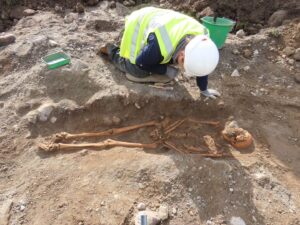
Testing comprised the excavation of three test trenches, which were positioned to target the anomalies identified in a geophysical survey, and test the footprint of the proposed development. The geophysical anomalies were revealed to be associated with areas of disturbance, modern infill and abandoned services, all relating to previous developments at St Joseph’s Place. However, human remains consisting of the lower legs of an in-situ adult skeleton were uncovered in the south-east part of the site. Excavation was recommended and this took place in October 2023 when an area measuring 10m², and centered on the human remains discovered during testing, was topsoil-stripped and investigated. A second burial and a small deposit of disarticulated human remains were found and excavated.
The burials consisted of two adult male skeletons. The similar alignment and close proximity of the two burials suggest they are broadly contemporary, and it was considered that they are probably associated, either directly or indirectly, with the recorded early medieval cemetery (GA087-083001), located c.50m to the south. A bone sample from one of the skeletons returned a late 8th to late 10th century radiocarbon date, which is significantly later than the radiocarbon dated bone sample from the 2018 excavation, and the bronze pin recovered by the National Museum in 1955, both of which are dated to the 6th/7th century. It is suggested that the two burials are outliers, possibly representing evidence for the re-use of a site with a long-established burial tradition. No further human remains were uncovered during subsequent monitoring of topsoil removal across the development site.