2023:569 - MOORETOWN (Castleknock By.), Dublin
County: Dublin
Site name: MOORETOWN (Castleknock By.)
Sites and Monuments Record No.: N/A
Licence number: 23E0311
Author: Gill McLoughlin, c/o Courtney Deery Heritage Consultancy
Author/Organisation Address: Lynwood House, Ballinteer Road, Dublin 16
Site type: Settlement deserted - medieval, Field system and Enclosure
Period/Dating: Multi-period
ITM: E 709520m, N 742500m
Latitude, Longitude (decimal degrees): 53.421233, -6.352274
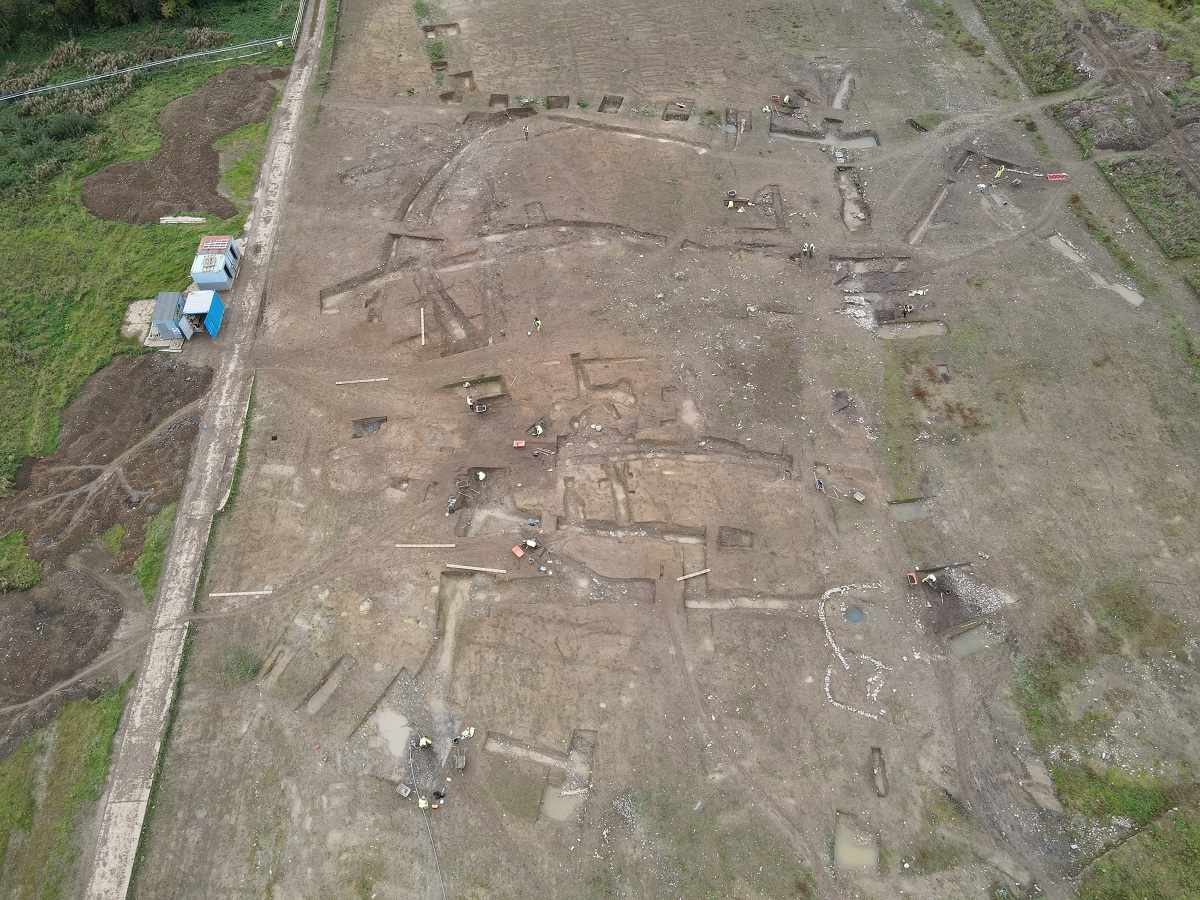
Excavations at Sites 2A, 3, 4 and 5 were carried out from May to October 2023 and followed on from geophysical survey and testing carried out in 2022. Site 2 was split into Sites 2A and 2B to facilitate the client’s programme. Site 2B commenced under an extension to the licence in February 2024 and will be summarised separately when complete.
Site 5 comprised a small burnt spread representing the ploughed-out remnants of a burnt mound which had settled into a natural hollow. The main element of the spread measured 7m x 5.6m and up to 0.14m in depth and contained occasional fire-cracked stones and rare charcoal inclusions.
Site 4 comprised a small sub-circular or oval enclosure with an entrance to the south. The enclosure measured c. 10m north-south x 12m and was defined by a shallow slot trench c.0.4m wide x 0.3m deep. The slot trench was less well defined around the eastern side of the enclosure and is likely to have been truncated from above. Despite a lack of dateable finds, this site is thought likely to be prehistoric in date, although scientific dating is awaited to confirm this.
Site 3 comprised a circular ditched enclosure c.30m in diameter with an entrance to the southeast and a possible second entrance to the northwest. The ditch measured an average of 1.5m wide and 0.5m deep, with the exception of the area around the possible entrance in the northwest where it measured 0.6m wide and 0.25m deep. Two post-holes and two pits were excavated in the interior of the enclosure and probable middle/late Bronze Age pottery was recovered from one of the post-holes. In general, finds and environmental material was scarce, with very small amounts of animal bone and charcoal retrieved from the fills of the ditch. While a Bronze Age date is thought likely based on the pottery recovered, scientific dating of charcoal from the ditch fills is awaited to confirm if the post-hole was associated with the ditched enclosure.
Site 2A comprised the southern half of the overall Site 2. The area was initially indicated on geophysical survey, and testing confirmed the features were archaeological in nature. Excavation revealed a network of linear ditches, gullies, drains, pits and wells and most were associated with medieval pottery. This area appears to have been primarily related to land division and water management, with little firm evidence of actual dwellings or domestic plots, and the recovery of nine plough pebbles from this area supports the idea of it being primarily agricultural. However, the large volume of medieval pottery (mostly Dublin-type wares and Leinster Cooking ware) and the metal finds which include buckles, pins, keys and knives, is all indicative of domestic habitation. It could be the case that any structural habitation remains have been truncated beyond recognition or that they lie outside of the 2A excavation area. Many of the finds were concentrated in the northern part of Site 2A and this may be due to it being a low-lying area with higher ground to the north and south, resulting in material accumulating at the base of the slope, or it could be that the focus of habitation activity was located in the southern part of Site 2B, which has not yet been investigated.
A fragment of a line-impressed floor tile recovered from the site, identified from Eames and Fanning’s 1988 catalogue as a Type L79 , which dates to the later 14th/15th century, is a curious find in this rural setting and could be an indication that the location was once part of a monastic grange. Other L79 tiles have been found at Christ Church Cathedral, St Mary’s Abbey, St Patrick’s Cathedral, Bective Abbey, Malahide Church, Dunboyne Church and Newtown Trim Cathedral.