2021:801 - Ballycasey Beg, East Park, Shannon, Clare
County: Clare
Site name: Ballycasey Beg, East Park, Shannon
Sites and Monuments Record No.: n/a
Licence number: 20E0137
Author: Margaret McNamara, TVAS (Ireland) Ltd
Author/Organisation Address: Ahish, Ballinruan, Crusheen, Co. Clare
Site type: Enclosure, kiln
Period/Dating: Early Medieval (AD 400-AD 1099)
ITM: E 541450m, N 663950m
Latitude, Longitude (decimal degrees): 52.723477, -8.866733
Monitoring took place during topsoil stripping in advance of the construction of a warehouse and distribution building at Ballycasey Beg, East Park, Shannon, in a pasture field on sloping ground immediately south of the existing N18 between junctions 8 and 9. A number of potential archaeological features were identified during monitoring, including several ditches and furrows, a segment of curvilinear enclosure ditch and two kilns. As preservation in situ was not feasible, these archaeological features were subsequently excavated under an extension to the same licence.
Elements of an early medieval landscape were identified including boundary ditches, an enclosure ditch and a kiln. Also identified were early modern cultivation furrows and an undated gully. Another truncated kiln, although not dated, is likely to also be early medieval.
The largest ditch on site, likely a land boundary, was aligned north-east to south-west for a length of 86m within the site, continuing outside the western site limit. The ditch was 1.12-1.94m wide and 0.6–1.03m deep with a V-shaped profile in the east and becoming a broad U-shaped profile in the west. There were two small ditches perpendicular to this feature which likely represented small field sub-divisions. Another less substantial ditch, aligned west to east, was recorded for a length of 45.86m, with a terminus at the west and petering out at the east. The ditch was 0.54-1.12m wide and 0.22-0.45m deep with a shallow V-shaped profile. No ditch was directly dated, but two artefacts were recovered: a stone spindle whorl and a large sharpening stone.
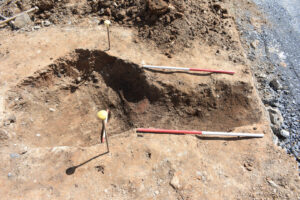
The larger cereal-drying kiln had a keyhole shape and was constructed on a south-west to north-east alignment. The north-east end of the feature, which was likely the drying chamber, was sub-circular in plan, with a diameter of approximately 1.3m, and was 0.49m deep with a concave base and moderately sloping sides; in situ burning was noted in its base. Extending south-west was the linear flue, 0.7m wide and 0.46m deep, with a broad V-shaped profile and moderately sloped concave sides. The flue was recorded for a length of 1.08m but was truncated at the south-west and the fire pit was not seen. A sample of charred barley gave a radiocarbon date of cal. AD 671-774 cal. AD (UBA-046989; 1281 ± 22), placing the kiln’s use in the late 7th to late 8th centuries.
A segment of curvilinear ditch, apparently part of an enclosure, was identified north of the kiln. Due to truncation of the site it was not clear whether the kiln would have lain within the circuit of the enclosure but it is likely that it did. The enclosure ditch had a terminus at the north-east and survived for a length of 11.43m; the ditch was 1.09-1.55m wide and 0.22-0.38m deep with a concave profile. Besides charcoal, the only material recovered from the ditch was a small amount of unidentifiable burnt mammal bone. A sample of charred wheat from fill of the ditch yielded a radiocarbon determination of cal. AD 776-991 (UBA-46990; 1133 BP± 22), placing the enclosure in the late 8th to late 10th centuries.
A second kiln, also truncated, was not dated but the cereal assemblage (dominated by barley and oat) suggests it was also in use in the early medieval period.